

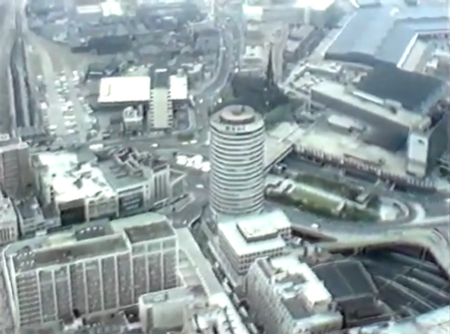
There are a million stories in the Second City. This is just one
Happy New Year! I hope that you’ve all had wonderful holidays spent with those dearest to you, doing things that you enjoy. And now it’s time to start imparting/absorbing (delete as applicable) wisdom, knowledge and experience about television again as you all head back to your campuseses campi places where all those university buildings are grouped together.
And when you get there, it’ll be that tricky second semester where it’s frosty and a bit grey, and your breath clouds as it meets the chill of the winter air. And that reminds me of Curriculee Curricula.
You’ve probably never heard of Curriculee Curricula. But that’s only fair, as it’s probably never heard of you either. It’s an odd piece of TV. It’s not commercially available and so goodness knows where you’d ever be able to see a copy.
How to describe it? Well, here goes. It’s a comedy prog rock opera about a plumber’s apprentice who is sent to retrieve some spanners left behind by Max & Harry Leavis (Jobbing Builders) from a university campus on the day of the Annual Nationwide Lecture being delivered by astronomer Patrick Moore and televised by a BBC Outside Broadcast team including presenter Magnus Magnusson. It’s a heady tale of romance, squash, boilers, surveys, motorcycles, jealousy, geographical confusion, and All Wisdom and Understanding – punctuated now and then by bold colourful graphics, bombarding the viewer Batman (1966-1968) style (other styles are available) with words such as “CRASH” and “BANG” with a side-order of “WALLOP”.
What the picture says.
Screened in mono (the only option) on BBC2 at 8.10pm on Monday 22 May 1978, the 50-minute Curriculee Curricula is of note as being the first British television ‘‘‘‘‘‘drama’’’’’’ (and, believe me, there aren’t enough nested quotation marks to do this word justice) to receive a simultaneous stereo broadcast on radio [i]. You’d had John Tavener’s Last Rites on that high-brow Radio 3 and BBC2 in June 1974, a few other classical music sessions with compositions from a lot of dead people, and oodles and oodles of Sight and Sound in Concerts featuring living people had graced both BBC2 and that funky Radio 1 from January 1977… oh, and Ingmar Bergmans’ The Magic Flute in The Lively Arts (1976-1981). But not much of yer actual ‘‘‘‘‘‘drama’’’’’’… until that Monday evening when you could hear and see Curriculee Curricula in stereo via BBC2 and Radio 4. And, remember, place your two speakers on the correct sides of the television… otherwise you’ll just end up feeling dizzy.
The creative talents behind this venture were established television playwright Alan Plater (who had trained as an architect at King’s College, Newcastle – latterly the University of Newcastle upon Tyne) and composer and keyboard player Dave Greenslade whose band Greenslade were exponents of prog rock [ii]. “For a longe time I have wanted to do something totally musical to spread the scope of our drama productions as wide as possible,” explained producer David Rose [iii] without the need to put any quote marks at all around ‘‘‘‘‘‘drama’’’’’’. And it was David that brought together Alan Plater whom he had worked with on the Chaucer-inspired travelogue Trinity Tales (1975) and Dave Greenslade who had scored the off-beat Birmingham gangland drama Gangsters (1976-1978), most recently blessed with a new theme song sung by Chris Farlowe.
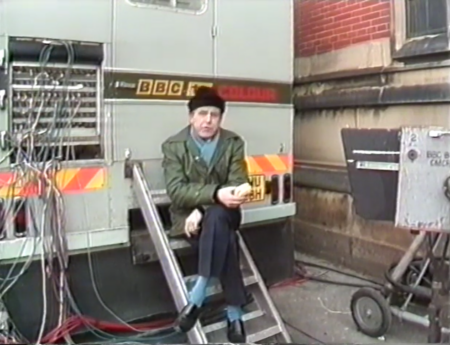
Magnus Magnusson will bring you all the action as it happens.
Now, this is the bit where the literature review – or lit rev as it’s known in the ed biz – should come. So, I’ve had a look jstor but – nope – sorry… all I got was a ‘No results found’. So, then I checked two of the best books about television that I know – The Making of Doctor Who by Malcolm Hulke and Terrance Dicks (Piccolo: 1972) and The ITV Encyclopedia of Adventure by Dave Rogers (Boxtree: 1988) – and they didn’t have anything helpful either, but – you know what? – that killed a few very happy minutes of joyous reunion with tomes that mean a lot to me while humming Solange’s blissful concerto from Les Demoiselles de Rochefort (1967). But, then again, as a senior academic told me a few years ago: “Lit reviews are dead boring aren’t they? You don’t want to read the same stuff again. You want to get onto the new bits.”
Unfortunately, the BBC Written Archives Centre was shut – because for me, here, now, this is still the chilly hinterland between Christmas and New Year – and so I couldn’t even ask if they had any T5/ files on the production, even less ask if one did exist if it had been vetted and opened for me as a mere member of the public to see in exchange for filthy lucre. Fortunately, you can nip up to the University of Hull where some wonderful archivists take loving care of the ‘Papers of Alan Plater’ at the Hull History Centre and you can read – I quote – ‘notes and related correspondence (Jan 1977-Jan 1978), a typescript entitled “Spanners: a television musical” (original title) and a rehearsal script’ courtesy of file U DPR/3/35. Good old University of Hull!
Anyroadup… SPOILERS ahead.
following an aerial shot of the Bull Ring (presumably poached from footage shot for Gangsters), the story (originally subtitled The Rocky Scholar Show) concerns Benny (rock, blues and soul singer Chris Farlowe) arriving on a university campus on his motorcycle and sidecar, and immediately being caught up in the simultaneous arrival of dignitaries for the Annual Nationwide Lecture, to be given by Patrick Moore – best known as the eccentric, passionate host of BBC TV’s astronomy programme The Sky at Night (1957-). Benny’s arrival is watched from a BBC Outside Broadcast van and commentated upon by the lecture’s presenter, Icelandic journalist Magnus Magnusson – best known as the host of the forbidding BBC quiz show Mastermind (1972-). Benny is quickly lost on the campus roads and finally receives some help in his quest to retrieve some missing spanners from the trendy, golden-jacketed student Maggie (singer Sonja Kristina, lead vocalist of the prog rock band Curved Air) whom he collides with while she is cycling. Directed by Maggie to the Admin Block, Benny is confronted by a postgraduate researcher (Gaye Brown) who needs him to answer a series of questions about which side of bed he gets out on and whether he prefers tall or short women with ‘Yes’, ‘No’ or ‘Don’t Know’. The researcher feels that Benny’s spanners could be located by the finest brains at the university, an eccentric set of figures – including the goose-stepping Professor Fauntleroy Himmler of Child Psychology, the spaced-out Professor Mercury Kubrick of Astrology and a moulting professor of ornithology – who form the Centre of All Wisdom and Understanding… but, sadly know nothing about spanners.
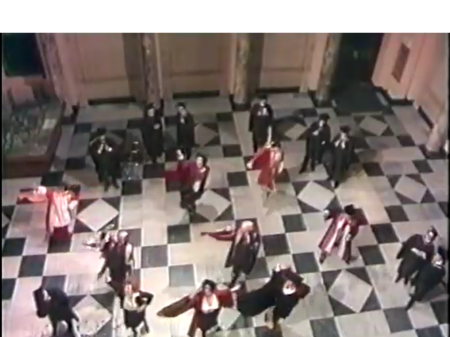
The Centre of All Wisdom and Understanding
Benny’s blooming friendship with Maggie has upset her supposed boyfriend, the competitive Simon (actor-singer Richard Barnes) who challenges the plumber’s mate to a duel of shuttlecocks in the gym. While Simon is undoubtedly the victor in a variety of sports that Benny neither knows nor cares about, it is Benny who departs the duel with Maggie and they head off to make love in the University Department of Central Heating. In the pipelined basements they are confronted by the Boilerman (deadpan veteran Glaswegian Chic Murray, probably best recalled by modern audiences from Gregory’s Girl (1980)). Offended by the use of his boiler house for erotic purposes, the Boilerman chases the duo up to the lecture being introduced by the vice-chancellor (Michael Aldridge) in a glorious pastiche of Gilbert and Sullivan’s I Am the Very Model of a Modern Major-General (1879). In an unexpected twist, the leather-clad Benny is mistaken for Patrick Moore and the lecture turns into a rock concert with music from the Greenslade. Benny finds his spanners, departing for adventures new with Maggie as an astronomer arrives declaring “I’m late/I’m late/For a very important date.”
All set to music. And utterly glorious!
It also feels like pure television. What television was made for. The mechanics of TV production themselves are on display throughout, with Magnus and the BBC team capturing all the action as it happens in the scanner van, and a wide-angle shot of the lecture hall including the hand-held camera operator lining up to capture the entry of the irate Boilerman from stage left. Video camera trickery of the day abounds, with Benny’s bike reversing from a ‘No Entry’ passageway, footballs bouncing in and out of his gymnasium goal, and the quartered screen as the luckless youth looks on with disdain at Simon’s pointless athletic prowess. There’s the TV jokes too, which I’m sure you’ll all get. When the postgraduate researcher asks Magnus Magnusson if he has seen Benny, he replies “Pass”. Magnus’ narration even opens with “There are a million stories in the Second City. This is just one.” That’s two references packed into one line!
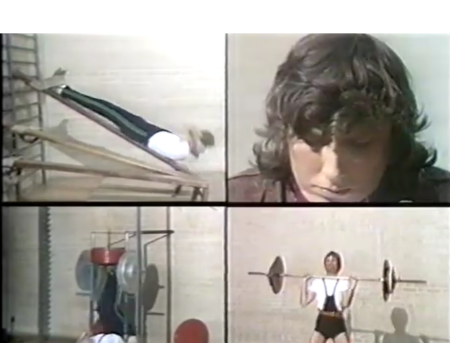
I Don’t Care
There’s also the period shots of a snowy University of Birmingham from almost 50 winters ago with its glistening snow around the Watson and Harding Buildings and its erstwhile paternoster lifts rolling endlessly around indoors. And the Great Hall of February 1978 where the rock concert passing itself off as the Annual Nationwide Lecture was performed. This forms the backdrop to a very class-ridden view of academia – where plumber’s mates are strange intruders into an alien world inhabited by phalanxes phalanxi phalanges ordered groupings of academics in fully robed and mortar boarded regalia.
“It’s a quality difficult to define and impossible to explain, but as Louis Armstrong used to say of jazz: if you have to have it explained, you wouldn’t understand anyway,” wrote Alan Plater of the production some years later [iv]. Alan would later return to tertiary education with the opening market research-related scenes of Oliver’s Travels (1995) set at the New University of the Rhondda Valley, while Dave Greenslade’s music provided a striking background to the surreal campus of Lowlands University in A Very Peculiar Practice (1986-1988).
So, if you do have 50 minutes spare and get chance to see it somewhere, you can study its class-based perspective on academic life, the bygone views of the Birmingham Campus, or you can unpack the technological techniques of the day…
… or you could just sit back, enjoy it and take warmth and delight from it as you return to teaching/studying (delete as applicable).
Happy New Year academia!
Andrew Pixley is a retired data developer. For the last 30 years he’s written about almost anything to do with television if people will pay him – and occasionally when they won’t. In 2025, he had the chance to read the most utterly, amazing, engaging and original essay about television, and he thinks it’s possibly the best thing he’s ever read on the subject. And in 2026 he really hopes that a smart publisher will pick it up so that others can be as impressed with the concept as he was.
Footnotes
[i] Sorry. You came all this way down here to expect a proper citation and it turns out that there isn’t one. Well, I’m sure I’ve read it somewhere over the last few years… that must be good enough, surely?
[ii] While the rest of you spent 1979 being hit by rhythm sticks, trying to cheer up Chiquitita or joining Oliver’s army, I was grooving on down to Dave’s mind-blowing fully-illustrated alien bible concept double album The Pentateuch of the Cosmogony. Wowsers!
[iii] ‘Students get rocking for a plumber’s tale’. Sunday Mercury, 26 February 1978, p12. See, I can do proper citations every now and then. Nice man David Rose. Met him once when he was researching down at the BBC Written Archives Centre.
[iv]. Grigor, Robbie (2009). Just Daft: the Chic Murray story. Edinburgh, Birlinn Ltd., p214. Alan was another nice man. Met him once at a Kaleidoscope event in Stourbridge and got to work with him on the DVD release of his Beiderbecke trilogy (1985-1988).

Fascinating read Andrew.
It was interesting to read about the simultaneous stereo broadcast on tv and radio. As a side it reminded me of the logistics of marrying up both ‘Sight’ and ‘Sound’ in Concert. John Burrowes (OGWT/Riverside) described the sophisticated method:
“The sound engineer sat in Broadcasting House, wearing headphones, with a feed of the television sound in one ear, and the stereo radio in the other, and kept things in synch with a vari-speed control”.
Hello! Tim! Thanks for all your chair-related brilliance and everything else over the years!
And how interesting to hear about the concerts. I’m afraid the concept of simultaneous broadcasts rather passed by our household. We didn’t get stereo until 1979 if memory serves me correct… and I think the only thing we ever went to the bother of setting the speakers up for was Eurovision one year. Talk about middle class…
Fascinating stuff! Many thanks! I can imagine there’s a lot more to research in the world of simulcast. But probably very little of it connected with plumbers…
All the best 🙂
Andrew
Hi Andrew, you’re most welcome, and thank you for reading! I’m chuffed.
And thanks for pointing us in the direction of Curriculee Curricula. I’m trying to digest it, although I think it might take a moment. It feels like the intersection between The History Man, Pebble Mill at One, a TV-am seaside special (albeit not near the coast) and a Eurovision ‘postcard’. It’s marvellous.
However it is categorised, I’m drawn to your comment, “It also feels like pure television. What television was made for.” It reminds me that David Rose was never afraid to break the fourth wall of television production, just as the very end of Stargazy on Zummerdown and series 2 of Gangsters breaks the illusion by tracking to a wide shot of the multi-camera studio.
Oh, that *that* videotaped look – wonderful.
Thank you again, Andrew.
Best wishes, Tim.
Hello! Tim! Let’s see if there’s space here or if it’s got too stupidly narrow…
Oh, getting a *bit* narrow… but still do-able! Let’s persevere.
It’s quite a thing to digest isn’t it… but all the more glorious for it. Like when you watch a form-subverting episode of “Moonlighting” and go: “WOW! I didn’t know that television could do that!” And I *love* your description: ‘the intersection between The History Man, Pebble Mill at One, a TV-am seaside special (albeit not near the coast) and a Eurovision ‘postcard’’. Yes! Quite! That’s utterly brilliant!
And, yes, David Rose *did* take chances. My wife and I admiring the early episodes of “Z Cars” on TPTV at the moment… and – my goodness! – the things that they’re attempting to do with storytelling and production are amazing for 1962. And Series 2 of “Gangsters” – however unbroadcastable it may now be – is still such a self-aware piece of televisual subversion (and with more great Dave Greenslade music!).
Thank *you* Tim. Most kind of you to comment. Glad you were as WOWed by this as I was. 🙂
All the best
Andrew
Hello Mr. Pixley,
I hope you can be of assistance to me…..i’ve been unable to find a used copy of the 4 CD SET of Edwin Astley’s THE SAINT. I’ve looked high and low on the web with no luck. And God knows what it would cost!
I’m a big fan of Mr.Astley music and the series itself has been a big favorite of mine since my youth..(yes I’m getting old !)
In any event, I would LOVE to read the liner notes you wrote for that boxset. It was the main reason I wanted to get the CDs. Would it be at all possible for you to send me a PDF of your liner notes.
It would be wonderful if you can..and please know they would be for my eyes only!
With many thanks for what you can do……..
James Graham
Hello James 🙂
Sorry that you’ve had such problems getting hold of this set… but it does just seem to have vanished doesn’t it?
As Network have now long since gone and the rights have reverted to me, here’s the text in case it’s of any use. But please note, I *don’t* have the final text; this is the pre-edit, pre-corrected version, so some of it may be wrong…
THE SAINT: The Colour Series
Music Composed by Edwin Astley
Original Saint Theme by Leslie Charteris
Accompanying notes by Andrew Pixley
Simon Templar – the “Robin Hood of modern crime” – is one of the most enduring fictional characters of the twentieth century, best known by the alias based on his initials: The Saint. The gentleman adventurer, thief and amateur detective was created by author Leslie Charles Bowyer-Yin – better known as Leslie Charteris – who was born in Singapore in May 1907 and, after a prolific and successful career, died in April 1993. The Saint first appeared in the 1928 novel Meet the Tiger! and went on to feature in around fifty books and short stories through to the early 1980s.
Already a popular literary character, Simon soon proved attractive as the focus for movies, with RKO casting Louis Hayward in 1938’s The Saint in New York after which George Sanders took over for The Saint Strikes Back in 1939; it was this film which introduced the Saint’s whistled signature theme – referred to as ‘No Saint Am I’ – and apparently devised by Leslie Charteris for Roy Webb’s music score. Sanders did four more films over the next couple of years, after which Hugh Sinclair took over the lead for a couple of title starting with The Saint’s Vacation in 1941.
Meanwhile, the Saint arrived on radio in the form of Terence de Marney in a series from Radio Eireann in October/November 1940, while Stateside he was personified as Edgar Barrier in an NBC radio series from January to March 1945, and returned in June to September the same year played by Brian Aherne, this time on CBS. A tie-in magazine, The Saint’s Choice, appeared from 1945 to 1946. Whistling the RKO Saint theme, Vincent Price famously played Simon Templar on the radio, first from CBS from July 1947 to June 1948.
Avon Comics launched a comic book of The Saint in 1947 which ran to 1952, and a syndicated comic strip of The Saint appeared from the New York Herald Tribune between September 1948 and September 1951. On radio, the Vincent Price series switched networks to the Mutual in July 1949, initially as repeats but with new adventures aired from January to May 1950. The show then transferred to NBC in June 1950, but Price dropped out and was replaced by Barry Sullivan for two weeks before The Saint was cancelled in September 1950; Price was reinstated and the series re-commenced in October 1950. Tom Conway took over the lead from Price from May to October 1951 (with Larry Dobkin standing in for him on one show in September).
Louis Hayward made a final movie as Simon Templar, The Saint’s Girl Friday (a.k.a. The Saint’s Return) in 1953. Spring 1953 saw the launch of The Saint Detective Magazine in the US, with a similar title appearing in the UK from November 1954. In due course this evolved into The Saint Mystery Magazine in November 1958 (January 1960 in the UK).
By 1962, it was time for Simon to feature in a new medium: Television. Having met in the Eighth Army Film Unit, cinematographers Monty Berman and Robert S Baker had founded Tempean Films in 1948 which went on to produce many British B-features. After negotiations with Leslie Charteris in late 1961, they secured the rights to adapt the adventures of the Saint as a filmed television series, and entered into a distribution and finance deal between their own company of New World, Granada Television and Lew Grade’s ITC organisation who had enjoyed success with well-crafted film series such as Danger Man.
The Saint was announced to the trade in April 1962 and soon Roger Moore was revealed as the new embodiment of Simon Templar; Moore had featured in series on both sides of the Atlantic such as Screen Gems’/Sydney Box’s Ivanhoe made in both England and California, and then the series The Alaskans and Maverick for America’s ABC network. Shooting started in June at ABC Studios in Elstree, and soon a music score was needed for the completed episodes. For this, Berman and Baker turned to composer Edwin Astley who had scored various film series including Danger Man.
“I suppose it was reputation that got me noticed,” Edwin told Vanessa Bergman and Michael Richardson in a piece which appeared in Action TV Issue 12 (Autumn 2005), “I was invited to a meeting with Monty Berman and Bob Baker, who wanted someone who could write music quickly, appropriately and cheaply… Leslie Charteris objected to The Saint theme as he considered it to be a pitch off a tune called Blues in the Night and he was also quite put out because we were not using his tune as he called it … Charteris accused me of plagiarizing my theme from him and in turn I threatened legal action if he did not stop claiming that I had stolen his work. Later, an American composer claimed to have written the whistling tune for the film and that Charteris had plagiarized it from him!” In the event, by the later episodes of the series it was agreed that cues which incorporated the musical motif No Saint Am I would include a note of Charteris’ apparent contribution, credited on the episodes as “Original Saint Theme by Leslie Charteris”.
The series proved highly popular with audiences after its début on ATV London on Sunday 30 September 1962, and appeared on ATV Midlands from Thursday 4 October; ATV was the ITV company affiliated with Grade’s ITC. Granada dropped out of production after the initial batch of shows, leaving ITC and New World to continue adapting Charteris’ work. Late in 1962, the Les Reed Brass recorded a cover version of Astley’s theme for The Saint as the B-side to a Pye single of another television theme, Dr Finlay’s Casebook (7N 35080); this also featured on other records from ATV affiliated companies such as Golden Guinea’s Top TV Themes in 1963 (GGL 0196) while sheet music was also available.
At the end of 1963, forty episodes of The Saint had been filmed by New World. By now, Leslie Charteris had effectively retired from writing, and further adventures for Simon were ghost written, such as the 1964 novel Vendetta for the Saint by science-fiction writer Harry Harrison. Back at Elstree, a further thirteen adventures were filmed between March and September 1964, then eighteen more from October 1964 to June 1965 when it was decided that The Saint would cease production as producers Robert S Baker and Monty Berman went their separate ways.
With The Saint still on air on ITV, the Danny Davis Orchestra recorded the Main Theme From ‘The Saint’ for MGM, released in July 1965 (MGM 1277). The show had also been successfully syndicated in the USA, and American audiences were treated to a soundtrack album associated with the show in October 1965: Secret Agent Meets The Saint from RCA Victor (LSP 3467). Astley recorded six pieces for Side B comprising The Saint, Recumbent Love (written with his friend Ken Jones), Halo (a cue composed for Danger Man), Staten Island Ferry, Cantina (again with Ken Jones) and The Saint Takes a Ride. In the UK, Astley issued a single of his themes to Danger Man and The Saint (RCA 1492) in November 1965.
In October 1965, it was announced that The Saint would resume production with a further batch of episodes to be shot in colour, and a colour pilot, The Russian Prisoner, was filmed during a break on The Baron in November prior to the main shoot in the new year. Having noticed the success of the series in syndication, the American network NBC wanted to pick up the show for broadcast. Since most of the practical Charteris stories had been adapted already, after the first few scripts the new production company Bamore – co-owned by Robert S Baker and Roger Moore – would be free to develop their own storylines. Shooting began in February 1966 with The House on Dragon’s Rock and continued to September, with this batch of adventures including work on a movie entitled The Fiction-Makers which would be released theatrically and not initially shown on television; this was given a U certificate by the British Board of Film Censors in September 1966, but not apparently released. Edwin Astley also took the opportunity to overhaul and expand his theme tune for the new colour title sequence.
Meanwhile, in April 1966 in the UK and May 1966 in the US, The Saint Mystery Magazine became simply The Saint Magazine; the UK version concluded in November 1966 while its US counterpart ran to October 1967. Meanwhile, the Eliminators recorded a cover version of The Saint for the Pye LP Guitars and Percussion in 1966 (NPL 16160) while in September 1966, RCA Victor released the American album Music from the TV Series The Saint (LSP 3631). This comprised the cues from the earlier RCA LP, plus Chaise-Lounge by Edwin Astley, Ying-Tong-Piddle-Ay-Kilt by Ken Jones, Mulligatawney by Ken Jones and Edwin Astley, Olaf’s Dance by Edwin Astley, Slinky by Ken Jones and Swinging Simon by Ken Jones.
Following a production break in September 1966, sixteen more colour editions of The Saint were then shot through to May 1967. Concurrent with this, transmission of the new show began in the UK, from ATV London on Sunday 25 September 1966 and ATV Midlands on Friday 30 September 1966. Broadcast quickly caught up with production, and by January 1967 repeats of monochrome episodes were being dropped into the run until new episodes were ready for screening. ATV Midlands concluded their run of the colour episodes on Friday 2 June, having omitted four of the instalments, while ATV London finished on Sunday 25 June, with three colour shows still to be aired. Meanwhile, NBC ran a batch of episodes from Sunday 21 May to Sunday 13 August 1967, and another cover of the theme tune appeared on the 1967 Studio Two LP Time for TV from Brian Fahey (TWO 175).
Fifteen more colour editions of The Saint were filmed from January to August 1968, including a two-part adventure, Vendetta for the Saint, which was allocated location shooting in Malta. Edwin Astley took the opportunity to re-arrange the series’ theme tune yet again. NBC screened further episodes from Saturday 17 February to 27 April 1968, and episodes such as Invitation to Danger and The Best Laid Schemes which had not previously been shown by ATV aired on other ITV regions during the spring. Following an ITV franchise reshuffle, ATV – now broadcasting in the Midlands only – resumed the series on Sunday 22 September 1968, finishing off the colour episodes from 1967 before moving onto the new ones, and also airing The House on Dragon’s Rock (previously deferred to a late night slot because of its content) and a two-part re-edit of The Fiction Makers before the series came to an end on 9 February 1969. In London, Thames started the new run on Monday 18 November (sometimes billed as The New Adventures of the Saint) and screened it through to 5 March 1969. In the USA, NBC then screened episodes from both colour batches from Friday 18 April to 13 June 1969. Cyril Stapleton’s cover version of the theme tune was also included on the Marble Arch LP Top TV Themes in 1969 (MAL 1179).
The Saint continued to be repeated by the ITV regions as late as July 1978, shortly before ITC debuted their revived version of the series, Return of the Saint, starring Ian Ogilvy as Simon Templar, and a cover version of Edwin Astley’s theme tune featured on the Pickwick release 50 Popular TV Themes by Bruce Baxter in 1977 (50DA 315). Only 24 episodes of Return of the Saint were made and aired on ITV from September 1978 to March 1979 before being networked as part of The CBS Late Movie from December 1979 to August 1980. Subsequent attempts to bring the Saint back to television as TV movies included The Saint in Manhattan starring Andrew Clarke in CBS Summer Playhouse (12 June 1987) and six adventures starring Simon Dutton shown on ITV in and syndicated as Mystery Wheel of Adventure in 1989.
Meanwhile, the movie versions of The Fiction-Makers and Vendetta for the Saint were released on the home video market by Precision in 1981, and appeared again a few years later from Channel 5 on VHS. A monochrome print of the episode The Queen’s Ransom was repeated in June 1982 by ITV in their Best of British season, and again – in colour – in December 1987 on Channel 4.
1990’s Power Themes 90 from Telstar (STAR 2430 LP) included a theme remix by Bruno Tilley entitled The Saint (Heroes and Villains Mix), while from 1991 ITC released a number of monochrome and colour episodes from the series on VHS. A revamped arrangement of the theme from Ministry of Ska featured on Themes from the 60s Vol 2 from Future Legends Records in 1994 (FLEG 2 et al), while The Saint formed part of the schedules for the satellite channel Bravo around 1995/1996, and Columbia House released episodes on VHS in America from late 1996. Mike Townsend arranged a new recording of the theme for Silva Screen’s The Cult Files released in October 1996 (FILMXCD 184).
Paramount made a movie of The Saint starring Val Kilmer for release in April 1997, and for the March 1997 soundtrack album the electronic band Orbital recorded a version of Astley’s theme (Virgin CDVUS 126), with the CD single charting in April (ZAC 179). BBC2 purchased the colour episodes of The Saint and screened them from March 1997, while Polygram issued the two movie edits again on VHS. Razor & Tie/BMG re-released Music from the TV Series The Saint on CD in August 1997 (RE 2156-2) and the CD Serialement Votre the same year featured a further reworking of the Astley theme by Dr Pheno.
Carlton acquired the rights to the ITC library and published episodes of The Saint on DVD and VHS from 2000, while A&E did the same in the USA. The RCA LP appeared on the CD Secret Agent/The Saint from Collectables Record in March 2002 (COL CD 2830), and the episode The House on Dragon’s Rock was included on the ITV DVD Cult TV Legends in July 2003. The Man Who Liked Lions was included on Network’s DVD ITC 50 in October 2005, and when ITV4 launched in November 2005, the colour episodes of The Saint were included in their line-up. 2006 saw the colour adventures released on DVD by both Network in April 2006 and also DD Home Entertainment, while a DVD partwork – The Saint Complete DVD Collection – appeared from Eaglemoss Publications in March 2009. November 2009 then saw Network release some of the music cues from the series on the double CD The Music of ITC.
Hope that helps! 🙂
All the best
Andrew