Brad Ingelsby struck gold with Mare of Eastown (HBO, 2021), a small town mystery series helmed by Kate Winslet and Jean Smart. His latest drama Task (HBO, 2025) also racked up critical acclaim. It is a tense yet dreamy thriller about FBI agent Tom Brandis (Mark Ruffalo), in pursuit of the criminal responsible for a series of robberies – Robby Prendergast – whose personal reflection, devotion to his family, coupled with the acting skills of Tom Pelphrey, make him the beating heart of the show. Task deserves all the hype. Ingelsby again captures Delaware CountyPennsylvania in a gritty yet atmospheric way. He knows what to give the audience and how and when to create the most suspenseful viewing experiences. And his characters are multi-faceted and multi-dimensional. Well, the men at least.
My gripe with Task is its tendency to sideline females, particularly after audience expectations were raised due to the stellar female characters in Mare. Defined only by their proximity to men, the women in Task pale by comparison. I know this is how TV works, characters need to relate to one another, and this show just happens to center around twomen, so naturally every character must be relevant by their proximity to them but, as I hope to prove, Task delivers plenty of material ripe for feminist analysis.
Maeve Prendergast (Emilia Jones) is a young woman burdened with the task of raising her cousins while herUncle Robby robs the houses of Dark Hearts gang members to avenge his brother’s murder at their hands. When we first see Maeve, it is apt that she is in the kitchen preparing a meal for the family following a recipe from Ree Drummond, a food blogger known as ‘The Pioneer Woman’, who embodies the idea of “traditional” feminine domesticity.
Maeve has no story beyond her cousins and her tragic backstory. She works a dead end job at a local arcade and, coupled with Arlie Hochschilds’ “second shift”[1], is prevented from developing her own ambitions even while shebriefly ponders a life outside her circumstances. In addition, Maeve resents her Uncle Robby for dragging her into hiscleanup efforts after a robbery gone wrong. The presence of Sam, however, the young son of a couple Robby and his accomplices just killed, tugs on Maeve’s maternal heart strings and ultimately leads to her getting one of the happier endings in the show. After a showdown with the leader of the Dark Hearts in the series finale, Maeve secures a bag of cash left to her by her now deceased uncle.
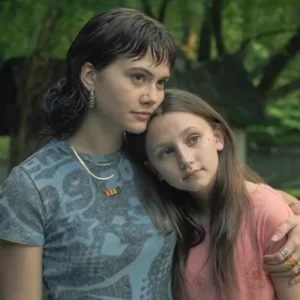
Her suffering and endurance have seemingly paid off, but there is a caveat. Maeve is now the only responsible adult in the lives of her cousins, and so she must assume the maternal role even more than before. While her ending is consideredhappy because she is free from the threat of the Dark Hearts and a million dollars richer, she is not yet, and perhaps never will be, free from the shackles of domestic labor. An unconventional mother of sorts, Maeve is part of what Andrea Press posits is a new era of feminism on television in which it “presents a third-wave-influenced feminism that picks up where postfeminism left off, introducing important representations more varied in race, sexuality, and the choices women are seen to make between work and family”[2].
Eryn’s (played by Margarita Levieva) story is even more grim. She is the wife of Jayson (Sam Keeley), leader of the Dark Hearts, and mother of his children. It is soon revealed that she is far more than that as, later in the season, she is exposed as the person leaking information about the gang’s drug deals to Robby. A move that enables him to strike at theoptimal time and take as much money from them as possible. As is common among these tropes of femininity, she is reduced to a love interest and little else when it is revealed that her motive is to spite her husband for killing the man she was having an affair with. It’s a badass move by Eryn, secretly avenging her love by interfering with the success of her husband, who struggles to prove himself as the newly appointed leader of the gang.
Her shtick does not last long, however, and eventually she is discovered as the rat by Perry. In a grueling face off between the two in an otherwise idyllic countryside lake, Eryn is killed after Perry brutally strangles and drowns her. We see a haunting underwater close up of Eryn’s wedding ring on her finger while the sun glistens above. Eryn’s death sceneleaves a bitter taste in the mouth of a feminist. Sure, she is not the only person to die at the hands of another in the series,but the personal nature of Eryn’s death is particularly cruel and is the price not only of her disloyalty to the Dark Hearts, but to her husband, who Eryn herself admits had stepped out on the marriage multiple times. This trend of violent deaths for women in media is common and can find its roots in Carol J. Clover’s description of female death in the horror genre where “The death of a male is moreover more likely than the death of a female to be viewed from a distance. The murders of women, on the other hand, are filmed at closer range, in more graphic detail, and at greater length.”[3]
Of course there are some characters who stand out as better examples of fully fleshed female characters, Agents Aleah Clinton (Thuso Mbedu) and Kathleen McGinty (Martha Plimpton) to name a few. In addition, this is not to say thatTask is misogynistic and my purpose is not to present a pessimistic outlook of the current television landscape. Plenty of shows on television right now are breaking boundaries in terms of representation, not just for women but for people of all identities. Rather, my hope is to suggest that identifying the ways in which television falls into misogynistic traps is a step in the direction of correcting and removing them.
Delanie Widdifield recently completed her MA in Television Studies at Rowan University and is spreading her wings as an independent writer. Her research interests are quality TV, HBO programming, and feminist film studies.
[1] Arlie Hochschilds, The Second Shift: Working Parents and the Revolution at Home (1989), 4.
[2] Andrea Press, Gender and Family in Television’s Golden Age and Beyond (2009), 139.
[3] Carol J Clover, Men, Women, and Chainsaws (1992), 35.