
Last week, I was in the incredibly privileged position of attending a panel discussion on the future of the BBC in the House of Lords, brought together by the British Broadcasting Challenge, a group of academics and industry insiders who’d like to see the continuation of the BBC, though they recognise that some reforms are necessary. The panel discussion featured speakers such as Armando Iannucci who highlighted how his own career as a critical commentator on contemporary politics was facilitated by the BBC and only by the BBC. This was an argument I found nicely repeated a few days later by a writer friend of mine who has just had the development of the children’s drama greenlit (‘who else than the BBC or the other PSBs would do that’ she said). In addition, Mark Damazer from the BBC World Service gave an acute assessment of what is going wrong inside the BBC while Polly Curtis from Demos spoke about the need to engage with citizens.
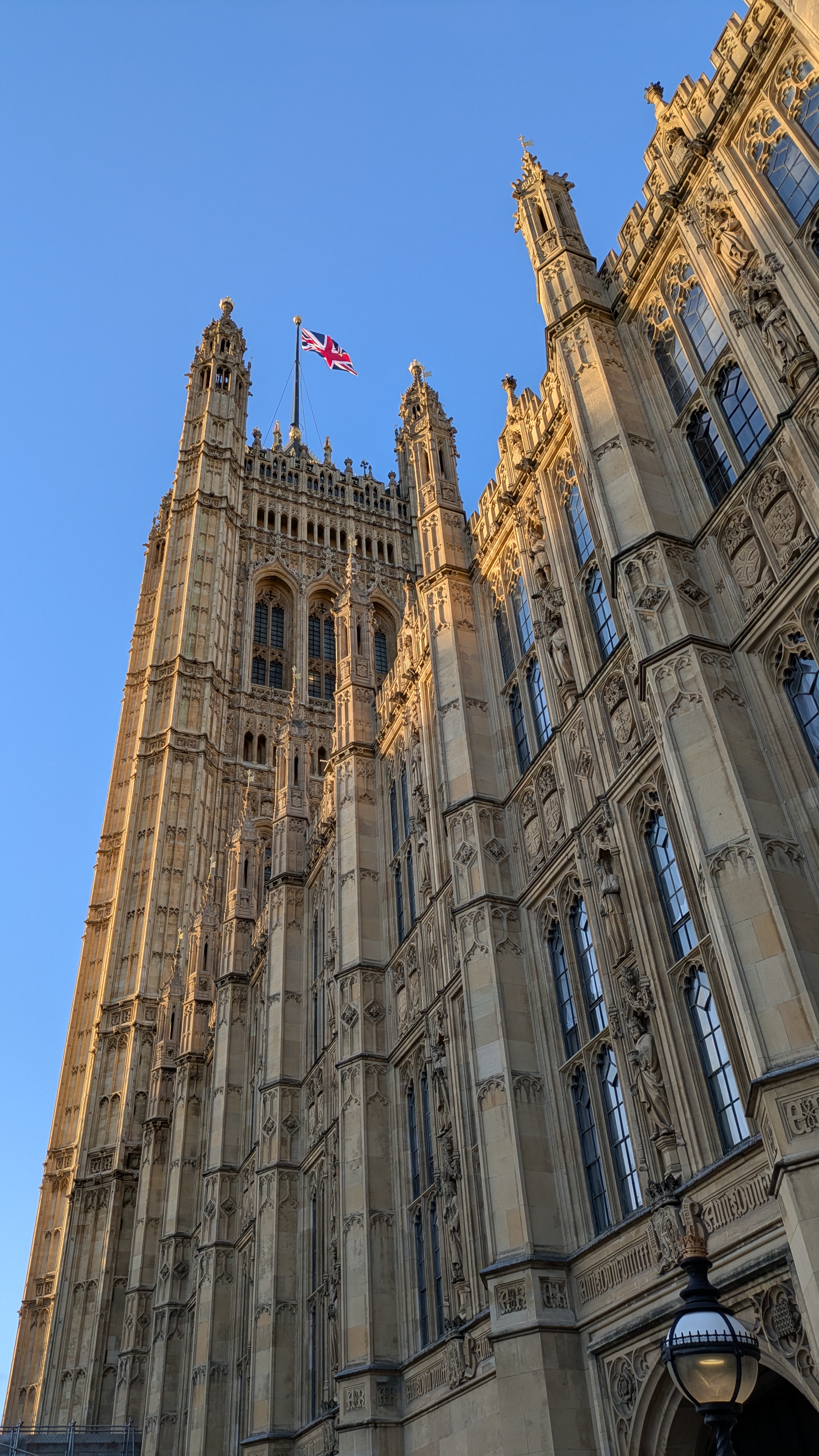
My close-up view on the House of Lords.
The panel was organised in the light of the impending publication of the Green Paper which will set out the British Government’s plans for the future of the BBC. This is necessary as the BBC’s charter is due for renewal in 2027. The Charter is the BBC’s constitution which lays out what role it has as a public service broadcaster, and how it should be governed. It exists only as a temporary charter as, when the BBC was initially established as a public service broadcaster in 1927, there was a belief that the need for a public service broadcaster would eventually be reduced as the market developed and provided that service, an argument that continues to reverberate (Armstrong, 2005).
Unfortunately, the market never provided, and it still doesn’t. On the contrary, the market of broadcasting and media more generally seems to be more dominated by a smaller and smaller number of internationally operating conglomerates. Comcast, one of the largest corporations, now owns not just NBCUniversal and all its subsidiaries, but also Sky in Europe. It is now trying to push into the terrestrial broadcasting market in the UK as well: ITV is in talks to sell its business to the same Sky Group. At the same time, we also see Netflix and Paramount Skydance fighting over Warner Brothers’ studios and streaming rights which – no matter which way it goes – will lead to even greater concentration of ownership and market domination in the UK and beyond: Paramount Skydance is another company with stakes in the UK broadcasting market as owner of Channel 5; Netflix continues to dominate the streaming market in the UK, and indeed beyond. And of course, all this is happening as the BBC saw a quite obvious attack by right-wing operators as I discussed a few weeks ago. Of course, all of this creates fears of how power is distributed and indeed increasingly centralised, particularly as these companies are commercial ones who are primarily focused on creating profit and thus see viewers (their attention and their demographic and affective information) as their main commodity, rather than considering how media may connect to ideas of public good. These fears, expressed by the British Broadcasting Challenge, are also clearly evident in a newly published report by the British Academy which is also worth reading.
These concerns are amplified because there’s now enough research pointing to some of the problems that the online delivery of television, news and media entails: platforms are designed to prioritise engagement with content made by the same platform (Hesmondhalgh and Lotz, 2020; van Es and Iordache, 2025), or that the filter bubbles that are created through personalisation and greater targeting lead to greater and greater division in our societies (Paliser, 2012; Park and Park, 2024). It is for these reasons that the British Broadcasting Challenge rightly demands a strengthening of the BBC which has historically and contemporarily had a remit not just to provide impartial information, but also to unite (the nation; see Cardiff and Scannell, 1987). This would involve making the charter permanent and the board independent of government appointments. The need for the latter became particularly apparent in the last few weeks, largely because a key member of the board, Sir Robbie Gibb, has been accused of interfering in editorial decisions, thus impacting on the BBC’s impartiality by being far too close to the Conservative Party, and in particular Boris Johnson, who indeed appointed him.
All of this returns me to a question that I have asked with David Levente Palatinus several times last year: that of governance. This includes how public institutions, such as the BBC, should be governed, but also what form of governance we want for society as a whole and what role the media should play in this. As I pointed out two weeks ago, our PSBs essentially present us with a view of society in which the benefits for all outweigh the benefits for each individual. Such a society is governed traditionally by sets of rules such as the Nolan Principles which are meant to guide behaviour in public office, but have clearly come under strain as they have been disregarded or discarded by some individuals. And this takes me a step further than the last blog I wrote, namely not just to consider what society we want and the values we subscribe to in defining it, but also to the question of what does that mean in terms of our individual responsibilities (including those of institutions).
This question of responsibility, I would argue, has been asked too little over the years, including in terms of our media consumption, where our focus has resided on wants, likes and needs, rather than what we perhaps should engage with. By focusing on wants, likes and needs, we have essentially treated viewers as children – a charge often levied at public service broadcasting, but that underlies conceptualisations of audiences as cultural dupes as well. What, I wonder, if we started treating viewers as adults, knowledgeable in certain areas but as humans limited. What if we ask these adults to participate more fully – a question raised usefully by people like Nico Carpentier (2011, 2016, amongst many) but also at the level of community media by Sarita Malik, Caroline Chapain and Roberta Comunian (eds. 2017). But what if we also framed their engagement with media in relation to citizenship and responsibility? These are obviously some of the questions that are posed in relation to media literacy (e.g. Christ and de Abreu, 2020) – but I believe we need to take them beyond that area and centre them across our debates of media policy and regulation. While this might be particularly useful for media that are operating within ideals of public service, it may be high time that we ask commercial media to reflect on this too.
Elke Weissmann is Reader in Film and Television at Edge Hill University. She’s published a few books on transnational television drama and has written a few articles and chapters on feminism and TV and climate change and TV. She is an ECREA editor for Critical Studies in Television. She is currently co-editing a book with David Levente Palatinus on TV and Sustainability. She migrated to the UK in 2002 after realising that German television was as bad as she remembered.