The fourth episode in the third series of Blue Lights begins in the home of Police Constables Grace Ellis (Siân Brooke) and Stevie Neill (Martin McCann). They are colleagues at the fictional Blackthorn station in Belfast and, surely to the relief of anyone witnessing their tentative courtship over series one and two, are now finally in a relationship and living together. We join them in the morning as they get ready for work. Stevie is brushing his teeth. Grace walks from the bedroom to join him in the bathroom. Their casual conversation spans a series of plot points in little more than thirty seconds: Grace calls Stevie ‘skipper’ in reference to his recent promotion to Acting Sergeant; she thanks him for backing her up last night when she pursued a hunch that saved the life of a teenage girl, Lindsay (Aoife Hughes); he mentions the fact that Grace has been asked to interview Lindsay later today; and they exchange concerns for a colleague, Annie (Katherine Devlin), whose mother has died and who is also the potential target of a credible murder threat. As Grace reflects on this, she begins to brush her teeth.
Writing down these assorted topics reminds me of how effortlessly Blue Lights balances complex storylines, keeping everything in play and keeping us guessing about where the next dramatic emphasis will fall. Indeed, we might start playing detective ourselves as the superb writing and finely detailed performances invite us to scrutinise intricate behaviour for possible clues. What did that look mean? Why did they reply like that? But the thirty-second run-through of storylines also recalls how deftly the show integrates points of extraordinary drama within a human reality. The exchange between Grace and Stevie is also about them. Their love for each other as they punctuate conversation with kisses and embraces, and their pride in each other for ‘stepping up’ to more senior roles as acting sergeant and interviewing officer respectively. It’s not difficult to see how this scene might be exposed as exposition through weaker choices – a clumsy phrase in the script, a misjudged emphasis in the delivery, a poorly timed cut in the edit. And yet, through careful handling, the disclosure of information is held within the everyday rhythm of a couple simply checking in before the working day begins.
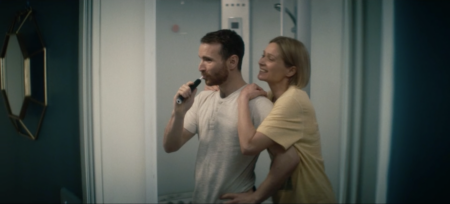
Stevie brushes his teeth
So far, so good. But I want to talk about the toothbrushes. Stevie’s is electric, whilst Grace’s is a standard plastic one. It’s possible that the difference is arbitrary, afforded little thought from anyone involved. Yet it seems at least likely that some degree of selection will have gone into props that actors will be putting in their mouths (potentially on repeat for multiple takes). I would be willing to bet that someone on the production team made a choice about Stevie and Grace’s toothbrushes. But why make this choice? Why decide, in the same scene, that one character should have an electric toothbrush and the other shouldn’t?
Well, an electric toothbrush has some associations with precision and diligence, process and rigour. It fits Stevie’s personality well. He is a more ‘buttoned-up’ character, hesitant to share details about himself and often concerned with doing things properly. These features are expressed in his professional conduct and personal interactions. Elsewhere too: his meticulous dedication to baking, with its processes of weighing and measuring, timing and checking, complement certain aspects of his personality. Perhaps these aspects became more acute after his wife died (a fact revealed in an earlier series) as he strove to regain balance and control in his life. In any case, we can certainly appreciate that he would make the effort to maintain an electric toothbrush (routine charging, changing brushes) because it’s the most efficient and effective option.
Grace, whilst an equally dedicated police officer, is more instinctive and improvisatory. Indeed, she was following those instincts when she ultimately saved Lindsay’s life the night before. So, while working within and appreciating the rigid systems of police procedure, she has a looser, more open approach to human relationships both in her professional work and her personal life. When Annie needed a place to stay in an earlier episode, for instance, it was Grace who offered up her home. It’s not difficult to see that, while of course thinking it’s important to brush her teeth, she’s perhaps less likely to bother with the faff of an electric toothbrush. Therefore, even in a scene where this couple are expressing love and admiration for one another, a feature of the mise-en-scène neatly reminds us of some lingering, underlying differences between them.
This would be enough. A clever choice of props subtly emphasising a minor faultline in a loving relationship, glimpsed while extended plot details are shared skilfully with the audience. But Blue Lights goes further. Later in the episode, it emerges that Grace has a connection to Lindsay not only because she was her social worker in a previous career but also because Grace, like Lindsay, spent her childhood in care. Her decision to share this knowledge in Lindsay’s police interview marks a turning point that will eventually lead to the downfall of a criminal network in Belfast. Lindsay was exploited and abused by that network and, when Grace tells her own story, it creates a bond that allows Lindsay to confide reciprocally in her. Grace describes her childhood as one of disruption, neglect and insecurity. What does a toothbrush become to someone in that unstable life? Something that can be packed up quickly on the move, perhaps. Something that needs to be functional and mobile. Something simple and cheap enough that it can’t be broken or stolen. And so, it’s possible that Grace’s use of a traditional plastic toothbrush in adult life carries a trace of her childhood that has, in turn, shaped her understanding of even mundane objects. Stevie’s electric toothbrush, in turn, might imply a childhood of relative stability and security. For him, there’s no need to question that using a toothbrush can rely upon a consistent supply of electricity and replacement brushes, for example. He simply comes from a different place. Trivial as their choice of toothbrush might appear, it has the capacity to reference deep-lying distinctions between Grace and Stevie’s experiences and expectations. When he learns the truth about Grace’s childhood, Stevie reacts angrily. His response seems extreme and unfair, but it perhaps makes more sense if he is struggling to process a fundamental loss of safety and order – replicating vicariously the anger Grace felt as a child but ironically directing it back at her.
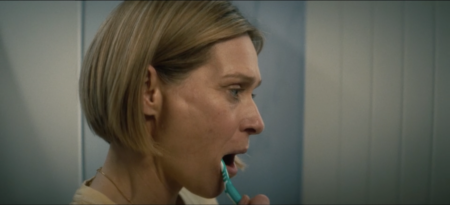
Grace brushes her teeth
Unsurprisingly, I think the choice of toothbrushes is especially well-judged. However, I also think it represents a wider pattern of excellent creative choices in Blue Lights. Whoever selected those toothbrushes understood something essential about the characters and knew what choices they would make (even if Grace and Stevie didn’t appreciate that they were making them). It doesn’t matter whether the decision came from the props master, a member of the dressing or standby props team, the writers, the director, the producer, a cast member or anyone else. Watching the show, I get the impression that a whole production team is dedicated to making the best onscreen choices so that, like the toothbrushes, any number of compositional features can come to possess compelling meanings and significance. This seems especially fitting, given that Blue Lights depicts a team of professionals also trying to do the best job they can (even if their approaches to policing sometimes contrast or conflict dramatically).
So, I simply want to say that the toothbrushes are a small indication of Blue Lights’ overall achievement. It’s a kind of careful attention to detail that reminds me of the expressive visual choices found in films from the classical Hollywood era, when creative units seemed to know almost instinctively which objects to place where, and how to film them, to create subtle yet profound significance. It could be said that celebrated US dramas like The Sopranos, Mad Men and Breaking Bad inherited those professional aptitudes sometime after Hollywood cinema had itself generally lost interest in sophisticated mise-en-scène. (Readers may recall Jason Jacobs writing a blog for CST that described the exquisite way a character in Mad Men held a coffee pot, for instance.) Yet, much as I have personal affection for British television dramas, I will concede that they never seemed to find these qualities consistently. Possibly I’ve been watching the wrong things, but I do wonder if UK productions might somehow have been hampered by the legacy of the British film industry over the years, with the foghorn symbolism of movements like ‘new wave’ social realism (or, worse still, the artistic wasteland of contemporary gangster movies) creating a somewhat unhelpful model for inspiration. But Blue Lights feels different. As a multi-character police drama, comparisons have been made with The Wire, but I would also suggest the show has a relationship to outstanding US dramas through its aesthetic ambitions. As a viewer, I’m struck by its depth and fluency. It’s a challenge to get close to those qualities in a critical response. I feel like I’m always falling short, missing something, or not going far enough. A less accomplished, less assured show might push its symbolic features anxiously to the surface, asserting them heavily to guarantee narrative impact. In contrast, those toothbrushes have a subdued presence as small elements playing their part within the dense fabric of Blue Lights’ fictional world. Easy to miss, but worth seeing.
James Walters is Professor of Screen Aesthetics of Criticism at the University of Birmingham. His new book, Visions in the Frame: Mise-en-scène Between Film and Television is published in June 2026.