Before going into detail on APV and localisation, I want to first focus on how Netflix has approached the topic. On the one hand, this means investment in so-called ‘local language’ self-produced originals. These texts are constructed in specific ways to appeal to a broad, transnational audience. Without going into the specific texts, it can be argued that the texts aim to explore transnational commonalities over differences. The more transnational texts align with what B.-G. Stolz (2021) terms for Netflix, “lowest common denominator programming” (2021, 155) only that, other than Netflix, Amazon clearly also targets a national one through other texts.
As will become clear, this is since Netflix constructs texts as transnational from the outset to address a transnational community while APV is often more targeted towards national communities. As Tessa Dwyer summarises,
The difference of the transnational (as opposed to the ‘international’, the ‘supranational’ and the ‘global’) is precisely its ability to interject grounding diversity into conceptions of the global. Whereas the term ‘global’ threatens to eclipse the national, ‘transnationalism’ acknowledges the continuing relevance of nations and national boundaries, enabling a more complex, embedded sense of how globalisation proceeds and manifests. (Dwyer 2018, 9)
Thus, the transnational text balances the global and the local in different ways.
Research into the transnationalism of Netflix has sometimes looked towards local catalogues, an approach pioneered by Roman Lobato (2019). This research highlights national differences as dictated by local legal and cultural frameworks. As Cathrin Bengesser, Matthew Hilborn and Jeanette Steemers (2024) summarise:
In studies of VoD catalogues, a distinction can be made between research that concerns catalogues as (structured) databases, and research that is concerned with the presentation of items within catalogues through publication strategies, algorithms, or interfaces. (2024, 3)
Considering APVs strategy of localisation, catalogue research may prove central in understanding this strategy in the next few years. This is especially true as licensing agreements in different countries can mean that films and TV series are only available dubbed.
Netflix has one access point, netflix.com, where users are directed towards national catalogues based on their IP address. For Amazon and APV, it is necessary to navigate to different pages to access it in different markets. Here, self-produced originals are available, but nationalised content can be hard to find and usually isn’t marketed outside of the source country. Thus, even more so than Netflix, APV is different in different markets. Additionally, streaming content bought in a different country cannot be accessed through the Prime app while travelling, due to licensing agreements.
APV emphasises the two axes of transnationalism: one zooming in on transnational commonalities (an incredibly un-nuanced good/evil binary, familiar narrative structures), the other on national differences (national humour, practices and rituals, or stars). The former is what I term here ‘transnational’ texts. These are often American or Spanish texts, such as the Spanish film trilogy Culpa Mia (González, 2023), Culpa Tuya (González, 2024), and Culpa Nuestra (González, 2025), based on a popular Wattpad story.
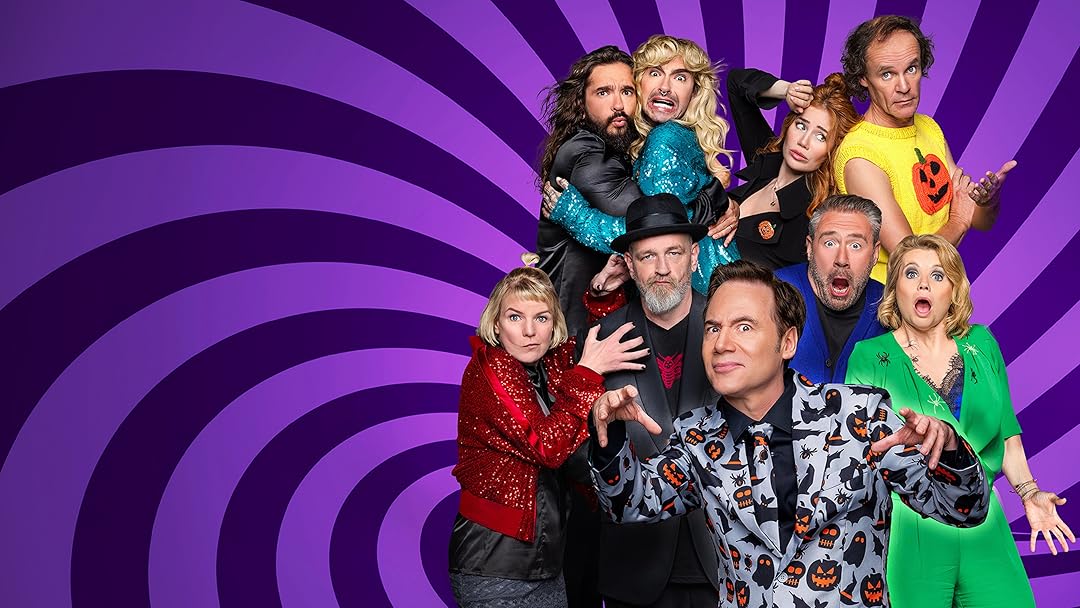
LOL: Last One Laughing – Germany: Committed to delivering local stars, local humour, and local comedy.
The second part of APV’s strategy responds more to cultural differences. They are ‘national’ texts, following the strategy the company calls ‘hyper-localisation’ (which often seems an awful lot like normal localisation), often national versions of franchises Modern Love and LOL: Last One Laughing, which rely on nationally established stars. LOL is a reality competition show where contestants are nationally known comedians who compete to not laugh while also trying to make each other laugh. A range of national versions are available, including a Mexican, French, Indian, or German version. LOL is committed to deliver local stars, local humour, and local comedy. LOL also often works as promotional platform for other APV series. In my current country of residence, Germany, LOL ties in with the limited series Perfekt Verpasst (Amazon 2024) or the Moritz Bleibtreu-vehicle Viktor Bringt’s (Amazon, 2024).
Perhaps the clearest indicator of who Amazon aims to reach are the languages in which texts are available. The Culpa-films are dubbed into a range of languages, including English, following a model set by Netflix. The dubbing into English is relevant, as, historically, the English-language market offers translation through subtitles, not dubbing. Tessa Dwyer outlines the discourses that led to a preference for subtitling in the English-language markets in detail. Netflix disrupted the industry by implementing English-language dubbing, which extended the reach of texts (Jenner 2018, 19-52).
Meanwhile, national productions, including franchises like LOL and series featuring its stars, are subtitled, but not dubbed. Much of that is owed to the genre of comedy, which is culturally specific and often based on puns and word play, which can be difficult to translate. It is thus, notable, that APV with its strategy of what it calls ‘hyper-localisation’ bets, particularly, on genres that rely on local cultural knowledge and local stars. The strategy seems like a direct opposition to Netflix’ approach to transnationalism and ‘local language’ productions. Because of that, it has more the appearance of a defensive strategy, but it also serves as a desperately needed counter-weight. Having said that, local streamers or catch-up services from PSBs obviously offer this counter-weight already, often more strongly grounded in local culture. However, APV also shows its commitment to local culture by featuring channels and collections that feature local content.
In that respect, genre is relevant. While the transnational viability of American sitcoms like Friends (NBC, 1994-2004), Modern Family (ABC, 2009-21) or How I Met Your Mother (CBS, 2005-14) cannot be denied, comedy often does not work outside of the local context. Denise Bielby and C. Lee Harrintgon explain,
the premise of situation comedy often resides in the temporary social rupturing of those bonds. Because cultures vary in their tolerance of the social contrasts exposed by humor and in solution to these contrasts, the resolution proposed in comedic narrative itself is very localized. (2008, 53–54)
Often, drama works better in transnational markets. Even more comedic transnational content on Netflix often carries melodramatic elements, such as the Mexican Club de Cuervos (Club of Crows, Netflix 2015-19), the German How to Sell Drugs Online (Fast) (Netflix, 2019-25), or the Spanish Manual Para Señoritas (The Ladies Companion, Netflix 2025).
It is the tagging system and system of algorithmic recommendations where the difference to Netflix becomes obvious. Netflix de-emphasises language and source country in its algorithmic recommendations. Thus, fans of costume drama are recommended a range of other costume dramas, regardless of whether it is Italian, German, or British. Amazon, however, has two parallel strategies. Language is de-emphasised for transnational content, but hyper-localised content is only marketed in the home market and, in fact, can be hard to find outside the territory.
Even APVs catalogues seem more local than those of Netflix. Much of this is linked to language and translation. Importantly, Germany is a country with a long history of dubbing. When looking at catalogues of both, licensed content and content for purchase, only dubbed versions of texts like The Nanny (CBS, 1993-99) are available. While the series has produced creative dubbing choices for elements that are difficult to translate (such as the cadence of Fran Drescher’s voice), the same is not true for a variety of films from Runaway Bride (Marshall, 1999) to The Queen (Frears, 2005). Usually, these pre-date streaming and licensing rights to the audio are limited. However, it highlights the relevance of national markets for APV in ways that go beyond Netflix’s approach to transnationalism.
Conclusion
Over the last few weeks, I have been grappling with what APV is. What tensions define it? How is it different from other streamers? And why did it not define streaming to the same extent as Netflix? APV stands in the tension between the broader company Amazon and streaming more generally, as well as the transnational and the national. In many respects, the history of APV can be understood through its relationship with Netflix, particularly in the early years of streaming. And yet, it also sits within the company structure of Amazon and needs to be understood in relation to aims and goals of the company. When asking what APV is for, the answer is decidedly different than for Netflix and Disney+. This also informs how the company operates and is perceived in local markets. Streaming may very well be central to its strategies going forward and many aspects (economic, cultural, political) are impossible to predict. At the same time, the sheer size of Amazon and APVs ability to integrate in local markets, make it likely that APV will remain central for streaming.
Mareike Jenner is a researcher in Media Studies at Anglia Ruskin University. She has widely published on streaming and is the author of Netflix and the Re-Invention of Television (Palgrave, 1 ed. 2018, 2nd ed. 2023) and the edited collection Binge-Watching and Contemporary Television Studies (EUP, 2021).
References
Bielby, D.& Harrington, C.L. 2008, Global TV: Exporting Television and Culture in the World Market, New York University Press, New York; London.
Bengesser, C., Hilborn, M. & Steemers, J. 2024, “Comparative VOD catalogue research: Circulation, presence and prominence of British content in Europe”, Convergence: The International Journal of Research into New Media Technologies, OnlineFirst, pp. 1–21. https://doi.org/10.1177/13548565241268057.
Dwyer, T. 2018, Speaking in Subtitles. Revaluing Screen Translation, Edinburgh University Press.
G.-Stolz, B. 2021, “National, Transnational, Transcultural Media: Netflix – The Culture-Binge” in Binge-Watching and Contemporary Television Studies, ed. M. Jenner, Edinburgh University Press, Edinburgh, pp. 145–61.
Lobato, R. 2019, Netflix Nations: the Geography of Digital Distribution, New York University Press, New York.