Two of the most beloved gen-x writer heroines have been widowed in recent years: Carrie Bradshaw (Sarah Jessica Parker) and Bridget Jones (Renee Zellweger). With the death of Big in the series premiere of And Just Like That (2021-2025) and Darcy in Bridget Jones: Mad About The Boy (2025), audiences who have grown up alongside these women are confronted with a significant question. Is the death of a woman’s long-term partner the going requirement for narrating the (peri/post)menopausal experience? Watching AJLT and the latest Jones in close succession, I couldn’t help but wonder: what do these narratives contribute to the growing discourse on romance, sex, and professional life for middle-aged women?[1] In both cases, the characters navigate the social and economic dimensions of (early) widowhood.
In Mad, Bridget first dates a handsome 20-something park ranger named Roxster (Leo Woodall) before settling into a seemingly long term relationship with Scott (Chiwetel Ejiofor), a teacher at her children’s school who—like her late husband Mark Darcy (Colin Firth)—is stoic yet warm. The romantic developments of the film call back to the original films with humour surrounding personal grooming and figuring out what to wear. Bridget is represented as relatable and, importantly, desirable. The more viable partnership with Scott though has to wait until Bridget can stand on her own as a parent and professional.
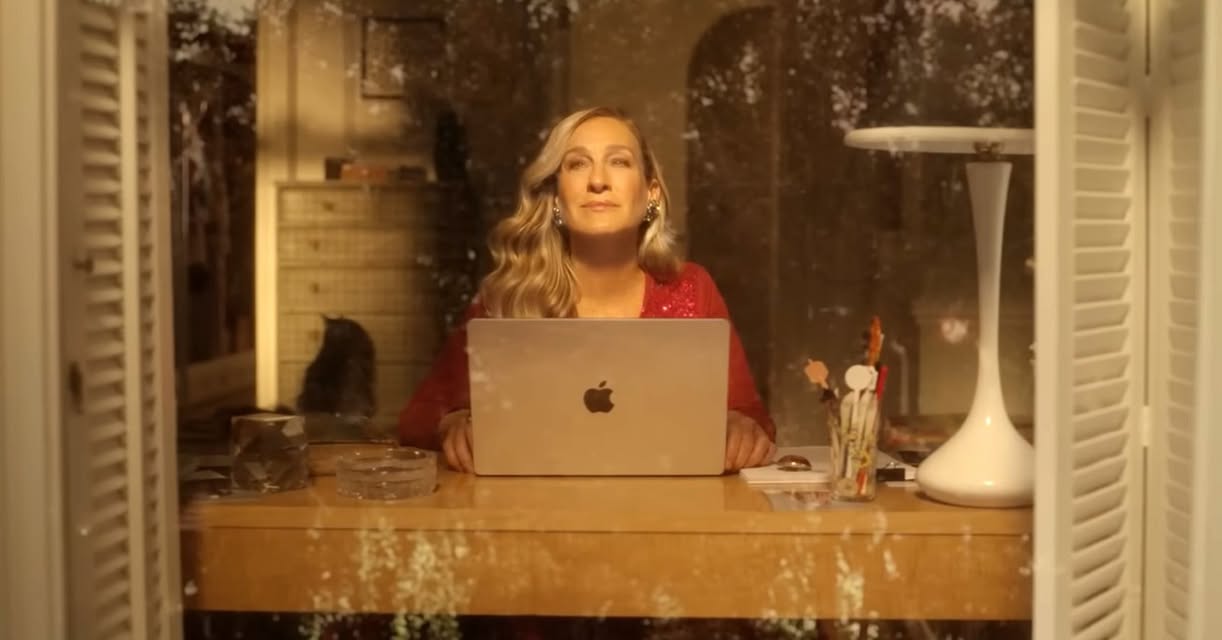
The familiar image of Carrie Bradshaw sat at her MacBook
In AJLT, Carrie briefly dates a few different men before reuniting, and ultimately breaking up again, with her former fiancé Aidan (John Corbett). The new show ends with the familiar sight of Carrie typing away on her Macbook in front of a window (Fig 1). The typed epilogue to Carrie’s new book also reflects her choices: “The woman realized she was not alone – she was on her own.” As Carrie softly dances through her fabulous townhouse, she seems not only at peace but satisfied with being single. On some level, the pleasure of the represented romances is predicated on their newness and yet both Scott and Aidan afford a sort of re-enactment either of the specific character (Aidan) or at least of the situations of the previous series (e.g. kissing Scott in the snow mirrors the kiss with Darcy in the first Jones) (Fig. 2). AJLT and Mad both raise the tension between the excitement yet inconsistency of early romance versus the comfort but potential boredom of a more established partnership. In both cases, coupling up or being single is represented as viable, desirable, and a choice for our now 50-something heroines. DING DONG.
The common inciting element is the sudden death of the rich husband. While both characters navigate their own grief journeys, the women are not left destitute with the loss of the household’s primary breadwinner, if anything they become more financially solvent. This is a privileged position that implies prior financial planning, management, and means. While both characters (and particularly Bradshaw) have long withstood cultural observations that they are somewhat fantastical economic concoctions, the financial ease of their widowhood may disconnect them from the average viewer.[2]

Bridget kissing Scott echoes her kissing Darcy in the original
Both narratives explore how paid work serves as a respite from grief—but not a financially necessary one. Their respective jobs provide openings to re-enter spheres from the previous instalments. Bradshaw co-hosts a relationship podcast and pens a memoir on love and loss that provides fodder for various publishing world encounters. In the final season, her decision to attempt fiction facilitates a professional friendship and then romance with her famous author-neighbour. While the prospect of living well in New York City on a one-column-a-week salary was already preposterous in 1998, now Bradshaw’s writing income is fully irrelevant given her spousal inheritance. Instead, the effort of creative work offers intellectual, professional, and social pay offs.
In Mad, Jones’ return to paid work at a television station harkens back to the original films. Similar to Bradshaw it is not financially but psychically motivated. Unlike the childfree Bradshaw, Jones’ return to work is largely motivated as an alternative to the barrage of domestic labour that she does as a single parent of school age children. After her first day, she thinks to herself, “am re-joining ranks of London’s employed, am meaningfully contributing to society and role model for children.” This voiceover communicates the complex sentiment that perhaps the best way to support her children as a single mother is by modelling professional accomplishment and ‘getting out there’ following the death of her spouse rather than personally responding to their every need. The voiceover occurs as Bridget crosses the same bridge in London as she does in the first film in the midst of pursuing a new career and taming her alcohol and tobacco addictions—the film uses this repetitive representation to assert how she gets her life under control at various stages.
Across AJLT and Mad, the optional return to work is profoundly shaped by class. In Bradshaw’s case it’s to avoid loneliness and boredom, in Jones’ it also re-asserts an identity in an adult professional sphere that is actually less draining than the emotional and practical labour of childcare. Both women hire domestic assistance to support their pursuit of professional goals. Bradshaw’s is more ad hoc but includes a private chef to facilitate dinner parties. Jones hires a nanny to take on domestic and care labour. While this might seem like it amplifies the disparities between our heroines and the average viewer, I think it’s an important acknowledgment that different modes of labour (paid and care and domestic alike) are all mutually connected.
Perhaps the most consistent aspect from the original installments is the group of friends around our protagonists. Both Bradshaw and Jones are anchored by new and long-running friends. While unravelling those social connections could be an entirely separate blog, the friends offer the most honest, supportive, and consistent modes of social engagement. While AJLT and Mad romanticize the established friend group, they also imagine how newer friendships offer vital connections in middle age life.
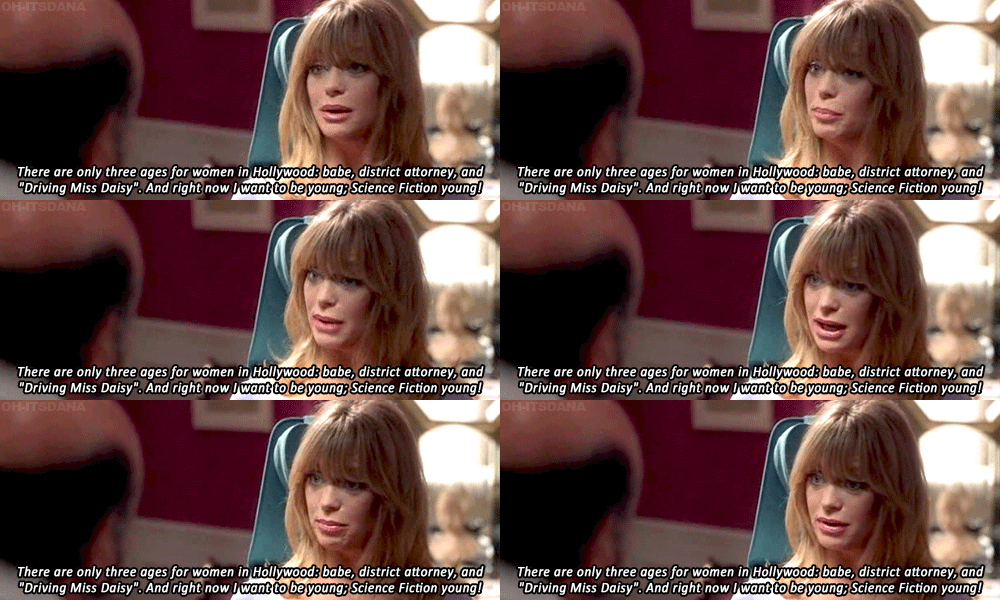
Elise Eliot (Goldie Hawn) in The First Wives Club (1996).
The growing representation of sexy, romantic, desiring, complex, and fulsome (peri/post)menopausal women is a net positive. As a millennial approaching 35—the age at which media of my youth led me to believe women cease to be desirable and become district attorneys (fig. 3)—I appreciate my gen-x sisters for prompting more frequent and transparent narratives that lead me to believe that yes, there is life after menstruation. And yet, there is still more work to be done to interrogate how class and race, among other social factors, shape how we understand and represent intimacy, work, and aging.
_________________________________________________________________________________________
Myrna Moretti is a Postdoctoral Fellow at Western University in London, Ontario, Canada. Her research evaluates the intersection of popular culture, gender, labour, and digital histories. She is also a filmmaker and video essayist. She holds a PhD in Screen Cultures from Northwestern University.
Fig 1. Carrie Bradshaw sits by her window typing, a familiar image from both SATC and AJLT.
Fig 2. Bridget Jones and Scott Walliker kiss in the snow, a moment that closely mirrors the final moments of the first Bridget Jones film between Bridget and Mark Darcy.
Fig. 3 Elise Elliot (Goldie Hawn) opines to her plastic surgeon about the three ages for women in Hollywood in The First Wives Club (1996). Charlotte York (Kristin Davis) on the original SATC similarly decides that she will “stick at 35”
[1] Some of the many examples of celebrities discussing their experiences of menopause in the last couple of years include: Donna Francis, “Celebrities in Perimenopause: Salma Hayek, Gwyneth Paltrow, and Michelle Obama share their symptoms,” Hello Magazine, November 19, 2024, https://www.hellomagazine.com/healthandbeauty/health-and-fitness/730260/first-signs-of-perimenopause-celebrities-share-symptoms/; “Our Story,” Respin by Halle Berry, effective December 4, 2025, https://www.re-spin.com/pages/our-story; Cara Lynn Schultz, “Jennie Garth, 52, Says Menopause and Body Pain Make It Feel ‘Like My Body Is Fighting Against Me’” People, August 7, 2024, https://people.com/jennie-garth-menopause-arthritis-body-pain-workouts-8691774; Naomi Watts, “Naomi Watts on Menopause and her Struggle to Get Pregnant,” Oprah Daily, January 21, 2025, https://www.oprahdaily.com/life/health/a63218654/naomi-watts-dare-i-say-it-excerpt/.
[2] Itzik Fadlon, et al. “Market Inefficiency and Household Labor Supply: Evidence from Social Security’s Survivors Benefits,” Working Paper 25586 (National Bureau of Economic Research,” https://www.nber.org/system/files/working_papers/w25586/w25586.pdf.