
‘I read the CIA Factbook, Christine, written by you. Britain’s entry: ‘slightly smaller than Oregon.’ I think that’s what it was. That’s what we are to you: slightly smaller than Oregon. Don’t think you can just order us around.’ Tom Quinn (Matthew Macfadyen), 2.6.
The above quote, spoken by MI5 agent Tom Quinn to CIA agent Christine Dale (Megan Dodds), illustrates a key plot point in episode 2.6, but also illustrates a key point in the interplay between geopolitics and international co-productions. That interplay, here between the UK and US, permeates not only the episode but the characterisation and aesthetics across the run of the series.
For those unfamiliar with it, Spooks (BBC 2002-2011; called MI5 in the US)[i] follows an ever-changing group of MI5 officers as they navigate both (inter)national and (inter)personal crises. For the majority of its run, the series was an international co-production between the BBC and the American basic cable channel AMC. Episode 2.6 features a main plot, in which the US president ‘suddenly’ decides to visit the UK, a subplot in which Tom’s ex-girlfriend, Vicky (Natasha Little) endangers Tom’s cover because of their breakup and a third subplot in which there is an accident with an American diplomatic crate. All of these plot lines intersect with the relationship between Tom and Christine, who resolve their unresolved romantic tension at the end of the episode.
The quote above, in which Christine is trying to dictate MI5’s actions during the presidential visit, occurs just before the subplot with the diplomatic crate begins. Because the French inform MI5 (accurately) that the presidential visit is cover for a meeting with the Libyans, MI5 arrange for an American diplomatic crate containing documents bound for the US Embassy to be opened and searched. During this, however, a mug of Earl Grey tea is inadvertently spilt into the box, soaking the documents. This does ultimately lead to the confirmation that the US and Libya are planning to have a formal meeting — and allows MI5 to stop a deal that they were negotiating — but it also showcases two things. First, it shows the premise that the UK is for ever subject to manipulation by the US and must, therefore, protect itself. One can perhaps view that as both a reference to geopolitical and industrial conflicts; as the latter would not be publicly stated there is no real way to tell, though geopolitical power imbalances can be read in international co-productions (cf Beattie 2023).
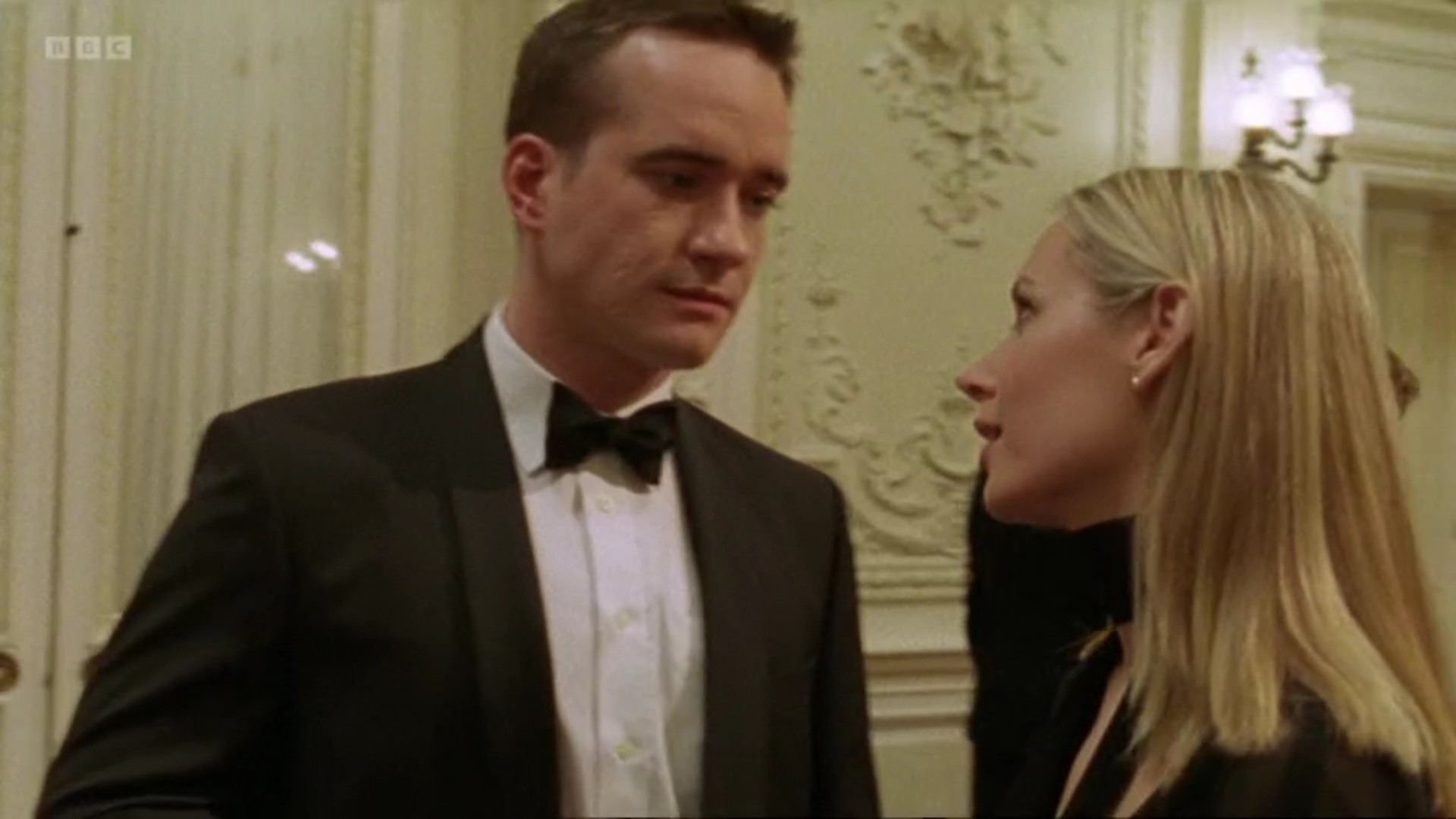
Adversaries to lovers. (2.6)
It is therefore the second thing that I shall spend the rest of the blog on: how this interplay is expressed through aesthetics. In contemporary TV studies, particularly when discussing ‘quality TV’, however defined, the importance of aesthetics is rarely questioned. Chapman (2020) argues that Spooks should be considered as British quality TV drama, in seeming contrast to perceived-American quality TV drama, (cf McCabe and Akass 2007 and Weissmann 2012 for the complexities of that perception), and focuses specifically upon its stylisation and aesthetics to make his argument. I absolutely do not contest that — in fact, in a forthcoming paper I discuss how Spooks’ aesthetics allow it to use the Gothic mode to showcase moral injury. Here, however, I would like to focus specifically upon the crate subplot, its relevance to both other plotlines in the episode as well as to how the series negotiated the very special relationship between the US and UK in its early series.
Oldham (2017) notes that Spooks was more subversive in its first two series than later on in its run; as the episode I am focusing upon is from series two, one can therefore read the themes of the episode as subversive. Comedic elements within the episode (and the wider series), in addition to leavening the geopolitics and creating generic hybridity, also support the idea of subversion. This subplot with the diplomatic crate is tied to both elements. The specification of it being Earl Grey tea can be read as connecting the episode/series with Star Trek: The Next Generation (1987-1994, syndication) whose British-accented Captain Jean-Luc Picard (Sir Patrick Stewart) ordered that beverage in most episodes.[ii] Yet Stewart also played the silent Russian spy codenamed ‘Karla’ in the BBC adaptations of Tinker, Tailor, Soldier Spy (1979) and Smiley’s People (1982). In the pilot episode of Spooks, in which MI5 are tasked with finding an American pro-life terrorist and rendering her back to the CIA, Tom is referred to, jokingly, as ‘George’ in the context of George Smiley. In my forthcoming paper, I talk about the overall duality and ambiguity of Tom’s character, but the crate subplot ties these elements, Smiley and Karla, together in a somewhat unexpected way for a spy drama: as a dirty visual joke.
(Those of you of a delicate disposition may wish to look away now).
The subplot, again, is about an Arsenal centenary mug full of Earl Grey tea being accidentally spilt into an American diplomatic crate. Another way to describe the subplot is that a large volume of British-associated fluid accidentally spurts from a large, also British-associated container into an American box.[iii]
Now that I have explained the joke thoroughly, I am unsure if anyone else will find it amusing or, indeed, be able to unsee it. But the rather literal objectification of the two characters does not only prefigure that they will get together romantically at the end of the episode. It also reiterates a point made in multiple episodes (1.5, 2.3 and 2.8 in particular) that the characters are viewed as objects by their respective (diegetic) governments. Extradiegetically, however, the characters also function as proxies, with the complexities of the geopolitical relationship between the US and UK illustrated through the interpersonal relationship seen on-screen. In particular, Christine unilaterally acts to eliminate the threat of Tom’s ex-girlfriend to his career and her own operation related to the presidential visit. Though Tom benefits from Christine’s actions, as with the quote with which I started this blog, he resents her exerting her/American power against a British threat (i.e., his ex) without his express consent. The main plot about the presidential visit does culminate with Christine allowing Tom/MI5 ultimate control against a perceived threat which turns out to have been an error, implying that British prudence (and subterfuge) has won the day and has won American respect. Tom and Christine ending the episode beginning a tryst in her flat as Tony Blair’s speech referencing the ‘very special’ relationship plays on her television behind them only reinforces their metonymy.
Geopolitics is complicated, as are personal relationships. In the case of Spooks, however, the personal is (geo)political as illustrated by the very special relationship between Tom and Christine. The strongly stylised aesthetics of the series do absolutely contribute to it (and Auntie BBC) positioning itself as a quality TV drama, however defined. But it is important also to recognise that such industrial positioning is not all that the stylised aesthetics can do. Like other parts of any given text, aesthetics can often be used to help reinforce and/or subvert the various discourses being conveyed as the preferred reading. And, in this case, it can also tease an ending (both of 2.6 and of later episodes I will omit to spoil) in which both characters get screwed by their and each other’s agencies and governments.
__________________________________________________________________________________________
Dr Melissa Beattie is a recovering Classicist who was awarded a PhD in Theatre, Film and TV Studies from Aberystwyth University where she studied Torchwood and national identity through fan/audience research as well as textual analysis. She has published and presented several papers relating to transnational television, audience research and/or national identity. She is currently an independent scholar. She is under contract with Lexington/Bloomsbury for an academic book on fictitious countries and Palgrave for a book on Canadian crime dramas. She has previously worked at universities in the US, Korea, Pakistan, Armenia, Ethiopia, Cambodia and Morocco. She can be contacted at tritogeneia@aol.com.
References
Beattie M (Forthcoming) ‘It’s Like A Hex’: Moral Injury As Expressed Through Gothic Tropes in BBC’s Spooks. Journal of Popular Television 13(2).
Beattie M (2023) ‘Something Else’?: International Co-Production, Postcolonial Crime Fiction and the Representation of Sexual Orientation in The No. 1 Ladies’ Detective Agency TV Series. Media, Culture and Society. Online first, https://journals.sagepub.com/doi/10.1177/01634437231179367 .
Chapman J (2020) Contemporary British Television Drama, 2nd Ed. London: Bloomsbury.
McCabe J and Akass K (eds) (2007) Quality TV: Contemporary American Television and Beyond. IB Tauris.
Oldham J (2017) Paranoid Visions: Spies, conspiracies and the secret state in British television drama. Manchester: University of Manchester Press.
Weissmann E (2012) Transnational Television Drama: Special Relations and Mutual Influence Between the US and UK. Houndmills: Palgrave MacMillan.
[i] A note on the inside of the American DVD release informs the presumed-ignorant purchaser that the series is referred to as Spooks in the commentaries.
[ii] A French spy in the subsequent episode is named Jean-Luc, potentially another homage or at least a name expected to be recognised by British and American audiences.
[iii] A ‘box’ being a somewhat archaic slang term for vagina or vulva and ‘tea’ being homophonous with the letter ‘T’, for Tom.

![BRUCE’S CHOICE <br> by not only Andrew Pixley [i]](https://cstonline.net/wp-content/uploads/2020/06/BrucesChoice_image02-440x264.png)