
A police officer who has become unpopular in his home department is seconded to a small island which is a French Overseas Territory. He arrives in a suit, which is incongruous to his surroundings and new colleagues, develops a relationship with his new partner, a Frenchwoman, which is by turns adversarial and potentially romantic. Over the course of the episodes, they solve murders through their mixture of intelligence, scientific skill and intuition.
No, for once, I am not writing about Death in Paradise[i] or any of its spinoffs.
I am instead writing about Saint-Pierre (CBC 2025-present), a Canadian series set and partially shot on the French Overseas Territory Saint-Pierre and Miquelon. For those unfamiliar with the series, Inspector Donny ‘Fitz’ Fitzgerald (Allan Hawco) arrests the premier of Newfoundland and Labrador– and his ex-wife’s new boyfriend– for corruption. These charges prove unfounded and Fitz is seconded to Saint-Pierre’s police force.[ii] There, he is partnered with Deputy Chief Geneviève ‘Arch’ Archambaul (Joséphine Jobert), a Parisienne who has been on the island for several years. She attended university in the UK (unstated as to where) and so speaks fluent English; though Fitz understands French he does not speak it. As such, despite being set on a French Overseas Territory, most of the dialogue is in English.
As the series only shoots its exteriors on Saint-Pierre, most of the cast are Canadians, shooting in St John’s as that is where all interiors are filmed. Visually, the sweeping shots of Saint-Pierre function in much the same way as similar shots in Death in Paradise and Shetland– they help create and convey a sense of place and distinction (Weissmann 2018, McElroy and Noonan 2019) which functions to draw and maintain an audience. They also seem to have become a trope of the ‘small/distant location crime drama’ subgenre, particularly given the increasing availability of drone cameras. Yet the Canadian cast and their accents (in both English and French) aurally functions in two ways. On Saint-Pierre, the French spoken is primarily Metropolitan, meaning that it is very similar to Continental French (Cormier 2023). Arch, being diegetically from Paris and played by a Parisienne actor, speaks Metropolitan French. The Canadian actors, however, speak Quebecois, which is a different dialect (Cormier 2023). When speaking in English, the Francophone Officer Renuf Aucoin (Jean-Michel de Gal) excepted, the actors have Eastern Canadian accents. By having Fitz speak in English but understand French, the series allows for his Newfoundlander accent to be heard, in contrast to the Mainlander accents of the Anglophone Canadian actors playing Saint-Pierre residents. This connects back to Republic of Doyle (CBC 2010-2015, hereafter RoD), Hawco’s previous series, yet the Newfoundland-specific dialect that was characteristic of RoD is absent from Fitz’s speech. While one can perhaps argue that this is diegetically for ease of communication with his normally Francophone colleagues, it also serves to differentiate between Saint-Pierre and Republic of Doyle. In addition, however, it renders Saint-Pierre as the Other(ed) location as, accent notwithstanding, Fitz’s Canadian English is intelligible to a Mainlander audience.
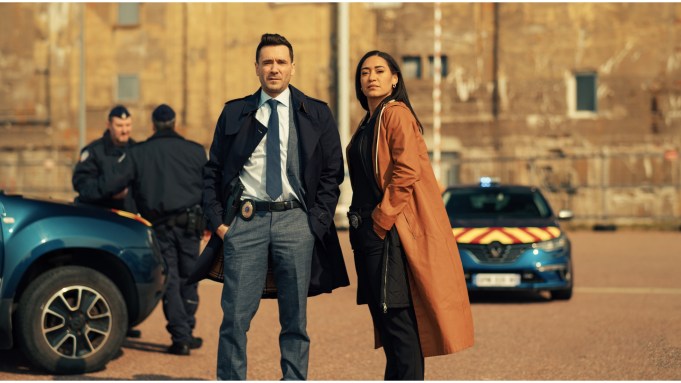
Much like I have previously noted about Death in Paradise (Beattie 2022), the fact that Saint-Pierre is a French Overseas Territory is not addressed, nor are the often complex relationships between such territories and their metropoleis. It is generally referred to as being in France– there is no definition or distinction between the island and the metropole, nor any explicitly distinct island identity– though in 1.8 it is noted that things move more slowly in Saint-Pierre by contrast to Continental France, though no reasons for that are discussed. Series antagonist Gallagher (James Purefoy, playing an Irishman) notes that small islands lead to resilient residents, but that is also somewhat nonspecific. As far as I can determine, there is no organised separatist movement in Saint-Pierre, but not engaging at all with its specific issues does tend to deterritorialise the series from its setting. Yet Canada itself has developed within a wider context of international relationships (Acland 2003, Hilmes 2012). The one most commonly studied is with the US, yet aspects of Saint-Pierre are telling regarding Canada’s relationships with its former colonisers, the UK and France. Hawco’s character being called ‘Fitz’ evokes British drama Cracker (ITV 1993-1996) and its complexities plus his character also analogises himself and Arch with John Steed and Emma Peel of The Avengers (ABC/ITV, 1961-1969) fame. Even the obvious homages to Death in Paradise (including casting Jobert) can be read as connecting to the tradition of British crime dramas and, because DIP is an Anglo-French co-production, it allows for a connection to be made between mostly-Anglophone Canadian media and French media heritage as well. Yet the US is still present; calling the character Fitz also evokes the American remake of Cracker, titled Fitz (ABC 1997-1998), the series’ second pathologist is vaguely Goth, suggesting an homage to the long-running American procedural NCIS’ (CBS 2004-present) original lab tech Abby (Pauley Perette) and the first series finale features a section which mimics Miami Vice (NBC, 1984-1989) down to the music (‘In the Air Tonight’ by Phil Collins) and the overall shot selection. Acland (2003) and Tinic (2005) both note the ambivalence and power imbalances between Canada and the US while my own research (Beattie 2020, 2025) has noted that Canadian texts will often use American cultural elements subversively. Yet none of the connections to either the UK, the US or France seem to be particularly subversive. If anything, they seem to directly connect to the wider Canadian relationships with its former colonisers and powerful, increasingly-unstable southern neighbour.
All of this, coupled with the main filming site being St John’s (the capital city of Newfoundland) and, as such, having a primarily Canadian cast– with their associated accents and dialects of English and French– makes Saint-Pierre seem more a part of Canada than anywhere else.[iii] Given that the series is not a co-production but solely Canadian (Hawco Productions for the CBC) this is not necessarily surprising as Canada has strict requirements regarding the number of production teams members and locations in order for a given text to qualify for tax rebates and similar support from the Canadian government (Beattie 2020). The series then seems to be connecting itself and Canadianness more generally to its former colonisers. Whether this is meant as tying itself to the cultural capital of Europe and European heritage in general or as directly opposed to the increasingly fraught relationship with the US is unclear. That said, while being surrounded and penetrated by an Anglophone mediascape rather than Quebecois or Acadian is sometimes given as the reason why Saint-Pierre’s French remains so close to Continental, the Overseas Territory does strongly identify itself as being part of France (Cormier 2023). It rather seems like the series is drawing upon the transnational success of DIP whilst simultaneously making some of the same choices to ignore the local conditions and relationships in favour of attempting to replicate a familiar version of the production’s home(s) that will be a draw for a domestic and transnational audience. And that does seem like a missed opportunity to try something new. Maybe next time…
_________________________________________________________________________
References
Acland C R (2003). Screen Traffic: Movies, Multiplexes and Global Culture. Durham: Duke University Press.
Beattie M (2025) ‘Everything to Everyone?’: Canadian National Identity and the Barenaked Ladies. Participations 21(1): 157-173.
Beattie M (2022) ‘You Can Get It If You Really Want:’ The Use of Caribbean Music Genres in Death in Paradise. Journal of Popular Television 10(3): 231-246.
Beattie M (2020) ‘Like An American But Without a Gun’?: Canadian National Identity and the Kids in the Hall. Participations 17(2): 3-24.
Cormier M (2023) A Metropolitan French Isolate in North America: the French language in Saint-Pierre-et-Miquelon. Tête à Tête: Journal of Francophone Studies 2(5): n.pag.
Hilmes M (2012) Network Nations: A Transnational History of British and American Broadcasting. London: Routledge.
McElroy R and C Noonan (2019) Producing British Television Drama Local Production in a Global Era. Houndmills: Palgrave Macmillan.
Tinic S (2005) On Location: Canada’s Television Industry in a Global Market. Toronto: University of Toronto Press.
Weissmann, E (2018) Local, National, Transnational: Y Gwyll/Hinterland as Crime of/for All Places. In K T Hansen S Peacock and S Turnbull (eds), European Television Crime Drama and Beyond, Cham, Switzerland: Palgrave Macmillan119–137.
[i] In addition to a paper (Beattie 2022), Death in Paradise is one of the case studies in my forthcoming book.
[ii] Given that Canada have no jurisdiction over a French Overseas Territory it is unclear how this could occur.
[iii] Newfoundland being considered a backwater by the series’ first pathologist in 1.2 can be read in this context (Tinic 2005).