
Though perhaps most recently in the public eye due to one of its co-creators’ appalling transphobia, Father Ted (1995-1998, Channel 4) is still considered to be one of the most popular British sitcoms (Harrison 2018). And it is that aspect of the series, its perceived-British identity, that I shall discuss in this blog. For those unfamiliar with the series, it follows three Catholic priests residing at a parochial house on ‘Craggy Island,’ ostensibly off the coast of Mainland Ireland. The titular Father Ted Crilly (Dermot Morgan) is exiled to the island (twice) due to accusations of embezzlement. His curate (assistant) is the childlike Father Dougal MacGuire (Ardal O’Hanlon) and they both are caretakers for the elderly Father Jack Hackett (Frank Kelly) a foul-mouthed alcoholic. They themselves are cared (?) for by their housekeeper Mrs Doyle (Pauline McGlynn). Though set in Ireland, its interiors were shot in Manchester; exteriors were filmed on the Aran Islands, off the west coast of Mainland Ireland.
Given that the history between the UK and Ireland is somewhat fraught (to put it mildly), with Ireland having historically been considered subaltern, one can perhaps read Father Ted in two ways, neither of which are mutually exclusive. The first is in the context of Conway’s (2013) paradox of saleable diversity, in which the saleability of diversity and its attendant distinction also serves to limit the expression of that diversity. In particular, it offers an unthreatening iteration of diversity; in this case, it can be read as showing an unthreatening Irishness. Given that Father Ted was produced in the waning years of the Troubles,[i] one can perhaps read the series in this way. As the series also avoided engaging with many of the most egregious abuses of power of the Catholic church and showed its priests as being incompetent rather than monstrous, one can read an unthreatening Catholicness in this way as well.
The second way in which one can read the series is that it is a case of what Spivak (1988) terms strategic essentialism. In order to oppose a negative stereotype or other monolithic representation by a group with higher sociocultural or geopolitical power, a subaltern group may opt to respond with an essentialist representation of themselves which is more positive. In the case of Father Ted, the denizens of Craggy Island, along with the priests themselves, are such exaggerated stereotypes that the absurdism may have precluded offence (cf Lloyd 2011). That said, one could just as easily argue that, by displacing such absurdist monstrosity onto a fictitious, outlying island rather than on the Mainland, the series is engaging with tropes more commonly associated with both negative stereotypes of rurality and even folk horror. I have discussed this concept before in the context of Scotland and the series Hamish MacBeth (BBC Scotland 1995-1997) in which I argue that the series subverts Gothic horror tropes and negative perceptions of the Highlands through its ‘cosy mystery’ genre. The absurdist comedy in Father Ted can accomplish a similar subversion, by rendering what might otherwise be thought of as threatening — remembering, again, that the series ran during the Troubles — as risible. That the production team were predominately Irish can also be read as both the coloniser speaking with the voice of the coloniser but, in so doing, subverting the negative essentialism with one which is created by the colonised. Whether viewed as strategic essentialism or not, the implication is that the Irish production team are in on the joke (cf Chiaro 2010).
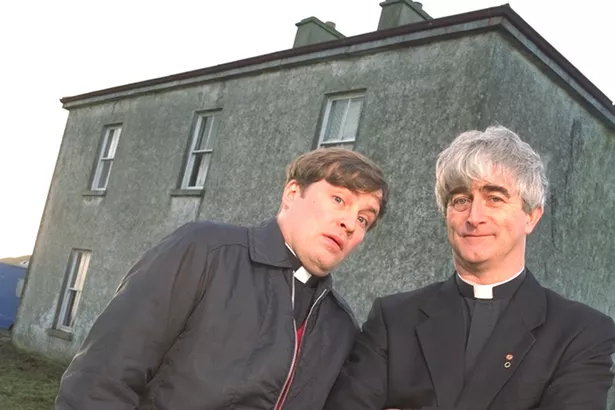
Regardless of how the series’ Irishness (Craggy-Islandness?) is read, fans of the series engage in an annual convention held primarily on Inis Mor (apart from 2022, presumably due to Covid). Termed ‘Ted Fest,’ its website states that it is supported by several tourism-adjacent businesses on the Aran Islands. While I am unaware of any academic work on either Inis Mor or Ted Fest, it is relevant that tourism itself can be tied to colonialism (Tucker 2019), with package tourists in particular coming over to see an iteration of a culture that has been, in essence, created by tourism companies. Thus, what is marketed as ‘authentic’ is constructed out of an expectation of what will sell (Gilman 2024). Fan tourism engages in the expectation that one is seeing a construction and that fans will engage in affective play during that time (Potts et al 2018) but the question then remains of how fans and residents interpret the local/regional and national identities and how they interpret Father Ted’s representation.
This, then, brings me back to the idea of Father Ted as a British series, as opposed to an Irish one. The series being a British representation of Ireland and the Irish, albeit an explicitly absurdist one, still plays with the power imbalances between the two countries. Yet the fan tourism aspect can be thought of as reclaiming the series and resituating it within Ireland, albeit one of the offshore Aran Islands, though a proper ethnographic research study would be required to truly understand the relationship.[ii] In this ambiguity and dynamism can perhaps be read the changing geopolitical relationships through which Hall (1995) characterises the postcolonial, reminding us that, regardless of time and space, the legacy of colonialism is neither small, nor far away.
________________________________________________________________________________________
Dr Melissa Beattie is a recovering Classicist who was awarded a PhD in Theatre, Film and TV Studies from Aberystwyth University where she studied Torchwood and national identity through fan/audience research as well as textual analysis. She has published and presented several papers relating to transnational television, audience research and/or national identity. She is currently an independent scholar. She is under contract with Lexington/Bloomsbury for an academic book on fictitious countries and Palgrave for a book on Canadian crime dramas. She has previously worked at universities in the US, Korea, Pakistan, Armenia, Ethiopia, Cambodia and Morocco. She can be contacted at tritogeneia@aol.com.
References
Chiaro D (2010) Laughing At or Laughing With? Italian Comic Stereotypes Viewed from Within the Peripheral Group. In G Dunphy and R Emig (eds) Hybrid Humour: Comedy in Transcultural Perspectives. Amsterdam: Rodopi, 65-84.
Conway K (2013) Little Mosque on the Prairie and the Paradoxes of Cultural Translation. Toronto: University of Toronto Press.
Gilman L (2024) Bits and Pieces: Exoticism and the Allusion of Authenticity in Southern African Wildlife Tourism. In J A Tolbert and M D Foster (eds), Mobius Media: Popular Culture, Folklore and the Folkloresque. Logan: University of Utah State Press, 39-66.
Hall S (1995) When Was the Post-colonial? http://readingtheperiphery.org/hall/ . accessed 20/11/22.
Harrison M (2018) Celebrating Father Ted. Den of Geek. (7 June). https://www.denofgeek.com/tv/celebrating-father-ted/ (accessed 14/6/25).
Lloyd M (2011) When Jemaine Met Keitha: Flight of the Conchords Tackle Australia. Continuum: Journal of Media & Cultural Studies 25(3): 415-426.
Potts L et al (2018) Participatory Memory: Fandom Experiences Across Time and Space. Enculturation Intermezzo Digital Press. Available at: intermezzo.enculturation.net/06-potts-et-al.htm
Spivak G C (1988) Can the Subaltern Speak? In C Nelson and L Grossberg (eds) Marxism and the Interpretation of Culture. Champaign: University of Illinois Press, 271-313.
Tucker H (2019) Colonialism and its Tourism Legacies. In D J Timothy (ed) Handbook of Globalisation and Tourism. Cheltenham: Elgar, 90-99.
[i] The Good Friday Agreement is from 1998.
[ii] If anyone has money and/or a job going spare, hit me up for a project design!