…the Government of Canada recognizes the diversity of Canadians as regards race, national or ethnic origin, colour and religion as a fundamental characteristic of Canadian society and is committed to a policy of multiculturalism designed to preserve and enhance the multicultural heritage of Canadians while working to achieve the equality of all Canadians in the economic, social, cultural and political life of Canada (Canadian Multiculturalism Act, 1988, R.S.C., 1985, c. 24 (4th Supp.)).
Though Canadian multiculturalism is often more an aspirational ideal than practice as I’ve found in earlier research (Beattie 2025), as the above quotes shows, the Canadian government have included it as part of their legal code. It is also the case that Canada is a common location for American media productions and has been for some time (Matheson 2005). It is in this context that I will be discussing representation in the series Stargate Atlantis (Syfy 2004-2009; hereafter SGA).
For those unfamiliar with the series, SGA is a spin-off from the series Stargate SG-1 (Showtime/Syfy Channel, 1997-2007) which is about aliens who masqueraded as gods during ancient history/-ies to enslave various groups from early human cultures. In the spinoff, a small team of multinational scientists and a small, mostly-American/US Air Force contingent travel through one of the titular stargates to the Pegasus Galaxy whence an advanced race of aliens came to Earth. It is this multinational aspect that I shall focus upon in this blog. More specifically I shall look at regular character Dr Rodney McKay (David Hewlett), recurring-to-regular-to-recurring character[i] Dr Carson Beckett (Paul McGillion) and recurring character Dr Radek Zelenka (David Nykl).
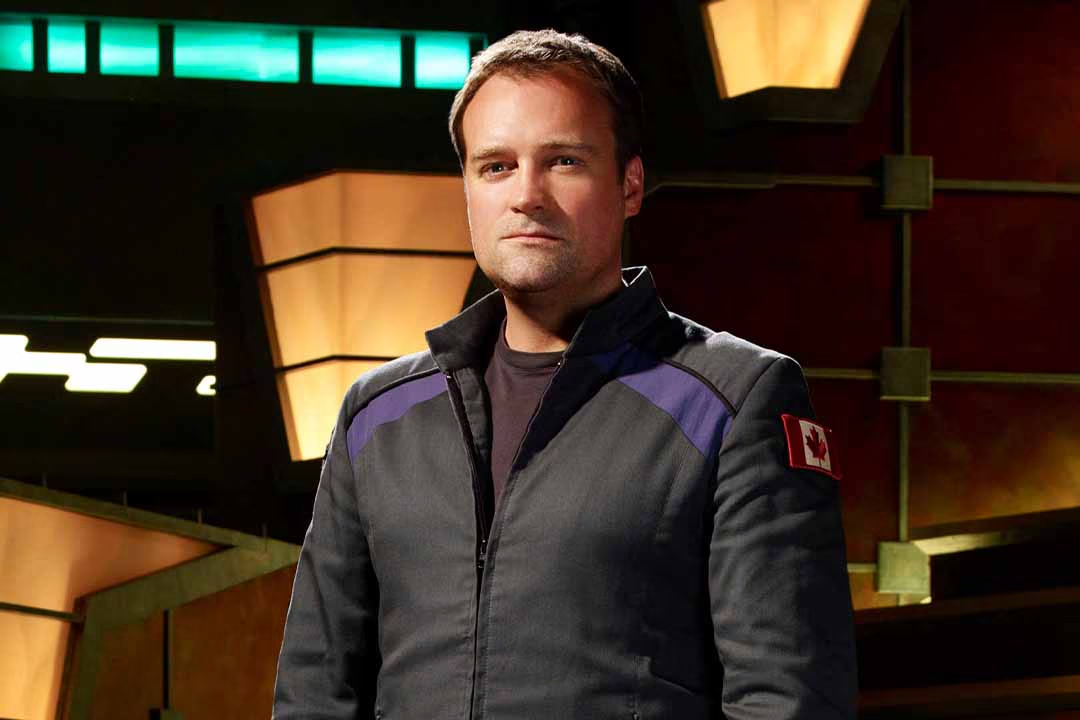
Dr Rodney McKay (David Hewlett) was both a Canadian character, and played by a Canadian actor.
Like many countries, Canada offers a tax rebate as a filming incentive. Their criteria for a series to qualify as an official co-production are quantitative (Edwardson 2008), with a requirement of one-third of the cast and crew to be Canadian citizens or residents. Yet SGA seem to be at pains to also engage with qualitative Canadianness, even though this is not a requirement,[ii] particularly regarding the multicultural ideal. SG-1, though taking place at what is, in reality, a shared command between the American and Canadian militaries, had exclusively American military personnel (and scientists) as field operatives. While many were played by Canadian actors, an explicitly Canadian character, McKay, was not introduced until series five of SG-1 and then subsequently included in SGA. McKay is a physicist and often a foil to Major, later Lt Colonel, John Sheppard (Joe Flanigan) and was initially an antagonist to the SG-1 team. In this one can argue he operates against the Canadian stereotype of being polite (Beattie 2025) but his prominence in the series and his eventual strong friendships with most of the other characters also can be read as raising Canadianness to being equal to Americanness. In the context of its Canadian filming location this can be read as showing appreciation — as well as its own Canadian-majority production team — but it also allows for Canadianness to move beyond its seeming characterisation as an interlocutor (Hilmes 2012) or as indistinct from American media (Straubhaar 2007).
Regarding Beckett and Zelenka, they also illustrate Canadian multiculturalism both diegetically and extra-diegetically. In the former case, both are explicitly marked as being Scottish and Czech respectively through accent, flag patches on their uniforms and, in Zelenka’s case, the frequent use of Czech. But both actors, though born in Scotland and then-Czechoslovakia, migrated to Canada as children and their accents in the series are modelled on that of their parents. Thus, by including not just Beckett and Zelenka but McGillion and Nykl, the series also promotes the Canadian multicultural ideal through immigration.
Yet, as I have found in my empirical research on Canadianness (Beattie 2020, Beattie 2025), I would argue that this multicultural ideal is still aspirational in SGA. To explain this, I must take a slight excursus into both the original Stargate film (1994, dir. Emmerich) and SG-1. The premise of the film, which carries over into SG-1, is drawn from von Daniken’s extremely problematic Chariots of the Gods (1968) in which he argues that the pyramids of Egypt were built not by ancient Egyptians but by aliens as landing pads.[iii] This has spiralled into not just tele-fantasy like SG-1 but also into such pseudo-science ‘documentaries’ as Ancient Aliens (2009-present, History Channel). In addition to the fact that there is no credible evidence behind the assertions that any monumental architecture from ancient Earth is of extraterrestrial origin, the foundation of the idea is based upon white/Europeans’ inability to accept that non-white, non-Christian peoples could have the engineering, scientific and organisational/political skills to create such works. This is a common finding in early archaeological/pseudo-archaeological work, particularly that done by colonisers; another example would be the assumption that the ancient Maya and/or other Mesoamerican cultures were descended from a ‘Lost Tribe of Israel’ (Fagan 2005). It is a fundamentally racist premise.
To be clear: I am absolutely not arguing that the film, SG-1 or SGA are intentionally supporting that aspect of the ‘ancient aliens’ idea. But it is also the case that the regular and recurring characters are majority-white, particularly those from Earth.[iv] While the presence and visibility of those from ‘small’ nations — here including Canada, even though it is the second-largest country in the world by area — does help to promote diversity, it is still somewhat limited, no doubt for the purpose of saleability (Conway 2013). No series can show the full range of humanity within it, and I do very much appreciate that SGA was clearly trying to broaden the range of representation within tele-fantasy. Yet, much as the Canadians I have interviewed in my previous and ongoing research have said, and much as the stargates (and the Stargate franchise series) themselves imply, there is still a long way yet to go before reaching the destination.
________________________________________________________________________________________
Dr Melissa Beattie is a recovering Classicist who was awarded a PhD in Theatre, Film and TV Studies from Aberystwyth University where she studied Torchwood and national identity through fan/audience research as well as textual analysis. She has published and presented several papers relating to transnational television, audience research and/or national identity. She is currently an independent scholar. She is under contract with Lexington/Bloomsbury for an academic book on fictitious countries and Palgrave for a book on Canadian crime dramas. She has previously worked at universities in the US, Korea, Pakistan, Armenia, Ethiopia, Cambodia and Morocco. She can be contacted at tritogeneia@aol.com.
References
Beattie M (2025) ‘Everything to Everyone?’: Canadian National Identity and the Barenaked Ladies. Participations 21(1): 157-173.
Beattie M (2020) ‘Like An American But Without a Gun’?: Canadian National Identity and the Kids in the Hall. Participations 17(2): 1-23.
Conway K (2013) Little Mosque on the Prairie and the Paradoxes of Cultural Translation. Toronto: University of Toronto Press.
Edwardson R (2008) Canadian Content: Culture and the Quest for Nationhood. Toronto: University of Toronto Press.
Fagan G (2005) Archaeological Fantasies: How Pseudoarchaeology Misrepresents the Past and Misleads the Public. London: Routledge.
Hilmes M (2012) Network Nations: A Transnational History of British and American Broadcasting. London: Routledge.
Matheson S (2005) Projecting Placelessness: Industrial Television and the “Authentic” Canadian City. In G Elmer and M Gasher (eds) Contracting Out Hollywood: Runaway Productions and Foreign Location Shooting. Oxford: Rowman & Littlefield, 117-139.
Straubhaar J D (2007) World Television: From Global to Local. London: Sage.
von Daniken E (1968) Chariots of the Gods. Düsseldorf: Econ-Verlag.
[i] …it’s complicated.
[ii] Such qualitative requirements can include relevance to the applicable country, as is the case for Ireland and Australia.
[iii] The late Dr Warren Barbour, an archaeologist specialising in Mesoamerica, once pointed out in a lecture I attended that the paperwork likely required to arrange monumental construction on another planet would, in and of itself, preclude monumental architecture being the work of aliens.
[iv] Two regular characters from the Pegasus Galaxy, Teyla Emmagen (Rachel Luttrell) and Ronon Dex (Jason Momoa) were played by BIPOC actors.