An officer in a bit of disrepute arrives on an island which is a French Overseas Territory…
No, I am not talking about Death in Paradise (Beattie 2022) or Saint-Pierre again.
I am, instead, devoting this blog to Tropiques Criminels (France 2, 2019-present, hereafter TC), known in English as Deadly Tropics. For those unfamiliar with the Francophone series– and only three of the six series are available in my region as of the time of writing, I should note– it is a (mostly) light drama which is both set and shot on the French Overseas Territory Martinique. It follows Commander Mélissa Sainte-Rose (Sonia Rolland), the officer referenced above. Her husband was a corrupt police officer so she left Paris for Martinique with her children from a previous marriage after he was imprisoned. She commands what in English would be termed the homicide division and is a thoughtful, methodical investigator. Her immediate subordinate (and de facto partner) is Captain Gaëlle Crivelli (Béatrice de la Boulaye), an impulsive if troubled woman who is also very good at her job. Together, they solve murders and engage in romantic relationships with men who inevitably turn out to be deceptive or badly-matched or are killed off.
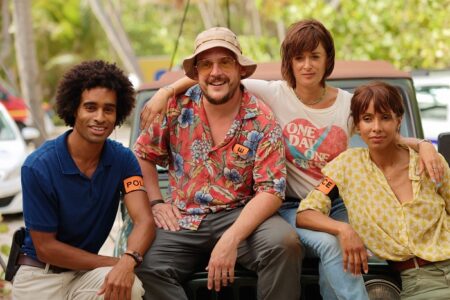
If this sounds familiar, it is very close to Death in Paradise (hereafter DIP) in concept in that both follow police officers from a metropole to an Overseas Territory where things are different. TC, unlike DIP, does often directly engage with sociocultural issues, particularly around gender with occasional intersectional issues. Sainte-Rose being Black, having mixed-race children and dealing with a sexist commissioner as her immediate supervisor are plot points in several episodes and hate crimes against the LGBTQIA community are also topics of episodes. Though it can still support conservative norms (e.g., Sainte-Rose refusing to help her son when he was arrested for defending his sister from an abusive boyfriend in 3.3, cf Turnbull 2010), each time, TC is on the side of the marginalised. This focus upon crimes against marginalised communities firmly positions the series as being (ostensibly/aspirationally) progressive. This also allows it to be distinct from DIP– or, perhaps more accurately, Meurtres au Paradis, the Francophone dub– in order to draw a different or additional audience. Its focus on female characters with authority also problematises the concept of ‘paradise,’ which focuses in part on submissive, sexually-available women (Tucker 2019). Though both Sainte-Rose and Crivelli are sexually active, neither is submissive.
That said, the series’ engagement with Caribbean folklore and syncretic religion, like DIP’s, is debunked in much the same way as colonialist thought prioritises Western belief systems and knowledges (Tucker 2019, Chi 2024), though 3.6 does offer some nuance in which Lieutenant Aurélien Charlery (Julien Béramis) argues that, while he believes in ‘energies,’ he does not believe that a woman is being visited by a dorlis (a local entity similar to an incubus) because it is attempting to hide itself from cameras. The Parisienne Sainte-Rose appreciates that he is not ‘blinded by belief.’ This at least allows for some space for Afro-Caribbean belief systems into the Western-style policing, though western thought again defines how and when such inclusion can occur.
Yet that, in and of itself, is part of the problem. As, like DIP, TC does not engage with the fact that Martinique is an Overseas Territory beyond an ill-defined rivalry between Sainte-Rose’s division and the National Police (la gendarmerie).[i] It does not displace Martinique from France in the way that I have argued Saint-Pierre does, but it uses the location for its Othered aesthetics (i.e., a Caribbean island) rather than directly confronting the complexities of the relationship between France and its overseas territories. Like many French Overseas Territories, Martinique has been subject to repeated separatist movements (Théodose 2019) which, though having led to increased autonomy have been largely unsuccessful (Bishop et al 2022). This is despite several scandals, particularly regarding the continued use of a pesticide in Martinique and Guadeloupe that had long been banned in Mainland France (Beattie 2022). None of this is addressed in TC. Though France is occasionally referenced in the context of it being distant (e.g., they regularly have to send samples to a lab in Lyon) by simply viewing the series one would never know that there is any potential conflict at all. One can perhaps view this as part of a touristic representation– though people are occasionally murdered they are usually locals and the police (led by an officer from Mainland France) will return everything to the approved law and order. Any tourists or potential tourists can, therefore, relax should they choose to physically travel. If they should opt instead for the (re)visiting through their screens, they still are unchallenged by questioning France’s control or even right of rule. Though one does see poverty, organised crime, trafficking and other problems, any connection to the fact that Martinique is a (post)colonial Overseas Territory or the fact that there is a separatist movement at all remains unacknowledged.
Given that TC airs on the French national broadcaster, it is perhaps unsurprising that, like DIP and the BBC, neither country’s national broadcaster directly addresses problems associated with their respective outremers. TC follows a parallel path, prioritising French/national law and order through Sainte-Rose even while it gestures towards the differences between the national and local, the metropole and l’outremer. Those who are suspects or criminals, though occasionally given sympathetic, if superficial, backstories, are viewed in an individual context rather than a sociocultural or (post)colonial one. It is this lack of nuance, coupled with the valourisation of the police that suggests that, much like many in its genre, it supports the status quo. While its (no doubt well-meaning) attempts at social progressiveness could have disrupted or at least problematised the metropole/outremer relationship, it still seems to be something of une propagande-flique.[ii] I hope that this dearth of engagement is based purely upon only having access to approximately half the current episodes. Yet somehow I doubt it.
_____________________________________________________________________________________
Dr Melissa Beattie is a recovering Classicist who was awarded a PhD in Theatre, Film and TV Studies from Aberystwyth University where she studied Torchwood and national identity through fan/audience research as well as textual analysis. She has published and presented several papers relating to transnational television, audience research and/or national identity. She is currently an independent scholar. She is under contract with Lexington/Bloomsbury for an academic book on fictitious countries and Palgrave for a book on Canadian crime dramas. She has previously worked at universities in the US, Korea, Pakistan, Armenia, Ethiopia, Cambodia and Morocco. She can be contacted at tritogeneia@aol.com.
References
Beattie M (2022) ‘You Can Get It If You Really Want:’ The Use of Caribbean Music Genres in Death in Paradise. Journal of Popular Television 10(3): 231-246.
Bishop M L J Byron-Reid J Corbett and W Veenendaal (2022) Secession, Territorial Integrity and (Non)-Sovereignty: Why do Some Separatist Movements in the Caribbean Succeed and Others Fail? Ethnopolitics 21(5): 538-560.
Chi C (2024) Madness, Psychiatry, and Empire in Postcolonial Literature. Houndmills: Palgrave Macmillan.
Théodose C (2019) ‘Martinique is Ours, not Theirs!’: Framing Conflicting Identities During the 2009 Protests. Postcolonial Studies 22(2): 168-187
Tucker H (2019) “Colonialism and its Tourism Legacies.” In Handbook of Globalisation and Tourism, edited by Dallen J. Timothy. Cheltenham: Elgar. 90-99.
Turnbull S (2010) Crime as Entertainment: The Case of the TV Crime Drama. Continuum: Journal of Media & Cultural Studies 24(6): 819–27.
[i] At the end of series three, it seems Sainte-Rose may become romantically involved with a (married) gendarme. If series four ever becomes available in the US or I manage to escape, I may write a follow-up blog.
[ii] This is the closest my uncertain French can come to ‘copaganda.’ Une flique, like the pun in the blog title (‘on fleek’) is French for ‘cop.’ It also connects to calling a film a ‘flick.’