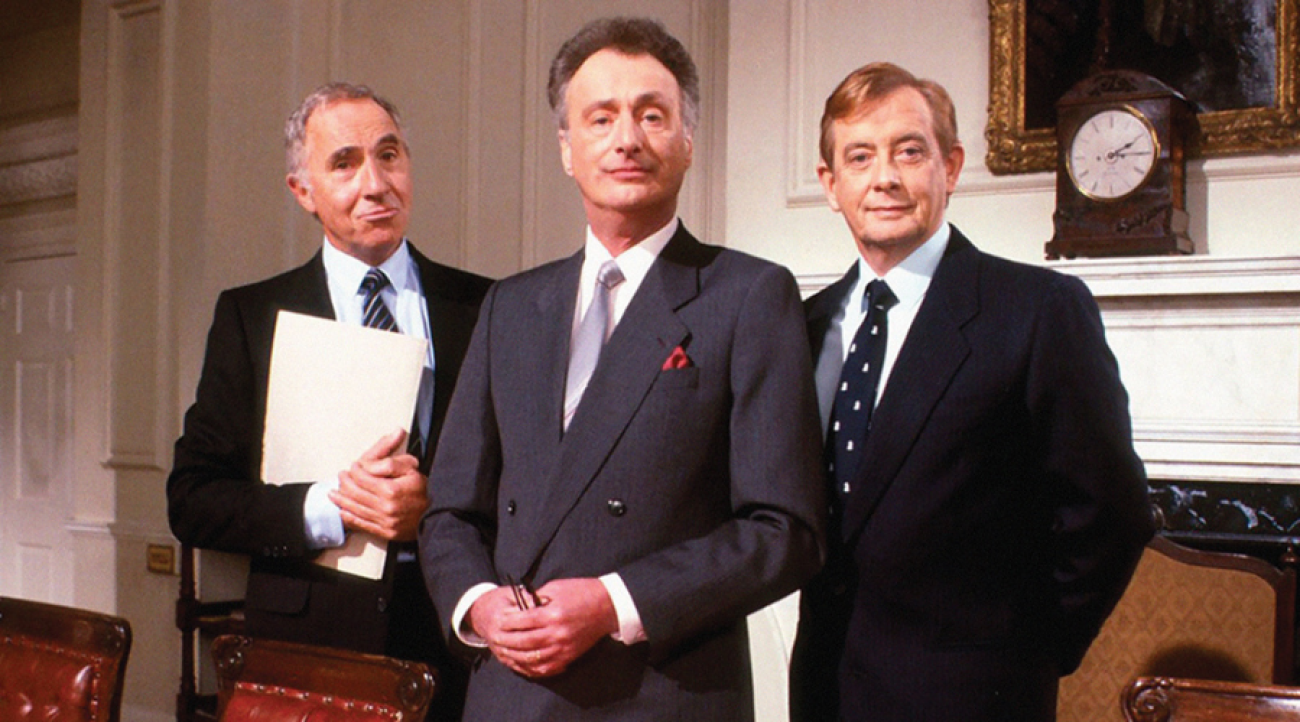
Like many academics who find themselves under a word limit, I recently found that there were a few fascinating case studies that I just could not fit into my forthcoming book on fictitious countries.[i] I have blogged about two of them before, both of which are outside my book’s geographic range; for this blog, however, I would like to focus upon a series which used two fictitious countries over the course of its run: Yes, Minister (BBC 1980-1984; hereafter YM) and its continuation Yes, Prime Minister (BBC 1986-1987; hereafter YPM). For those unfamiliar with the series, YM follows Minister for Administrative Affairs Jim Hacker (Paul Eddington) as he tries (and usually fails) to impact government policy and to advance his own position. After three series, he is ultimately made Prime Minister in the Christmas special. The subsequent two series (YPM) follow PM Hacker navigating his new position and all its responsibilities.
There are two examples of fictitious countries over the course of YM so it is that part of the series upon which I will focus. ‘Qumran,’ in 3.4, is a portmanteau of ‘Iran’ and the Iranian city of ‘Qom’ and is used primarily to illustrate Hacker and his staff flouting the Islamic proscription against alcohol during a trip to ratify a contract between a British electronics company and Qumran. The poor representation of Islam and the Middle East/Central Asia region, particularly during the series’ time period, have been quite well covered (e.g., Said 1981); in this instance various iterations of the Arab keffiyeh are worn by the Qumrani, which can be read as conflating or erasing Persian identity from the region.[ii] The other plot line of the episode pertains to whether or not an official gift given to the minister is too valuable to legally keep which ties into concerns about the use of bribery in order to secure the contract. While the implication is that the Qumrani– and, by extension, Arab petrostates– are corrupt, there is no consideration of colonialism, its impact on corruption or the wider geopolitical relationships that Hall (1995) argues are a hallmark of postcolonialism within the episode. It certainly does not directly address British interference in Iran over oil during the 1940s and into the 50s. As such, the series centres its then-contemporary white Englishmen and their potential for getting into trouble rather than those in the Middle East or Central Asia (cf Christian 2001 on postcolonial crime fiction doing much the same).
An example with more nuance is 1.2, which features the fictitious country of ‘Buranda,’ on oil-rich country to whom the British government would like to sell extraction equipment. This is a clear portmanteau of the former British colony Uganda (which has oil reserves) and the former Belgian colony Burundi (which does not have oil); diegetically, Buranda was previously called ‘British Equatorial Africa’ and is described as ‘the red bit on the left-hand side [of the map] just below the Mediterranean.’ When shown on a television later in the episode, it is clearly the former Spanish colony of Equatorial Guinea (which also has oil). Thus, the episode already elides the extremely complex sociocultural and geopolitical environment of continental Africa, not to mention the hundreds of different cultural groups on the continent. The overall plot line is that, after Hacker decides to move on official visit by the Burandan president to Balmoral to help his (never identified) party win some Scottish by-elections, Buranda undergoes a coup d’etat. Sir Humphrey (Nigel Hawthorne), Hacker’s permanent undersecretary and voice of the Establishment, is ostensibly concerned about potential problems with the new leader’s etiquette, particularly around the queen (though his main concern is being left out of the visit). In this, he is clearly representing colonialist perspectives on African nations as well as using them as a diegetically-shown pretext for his own concerns about his status. This contrasts with Hacker, who is positioned as being socially progressive, even whilst also using the visit to his own party’s benefit. Yet because the hypocrisy is on full display early on, it reinforces the critique of patronage systems that make up the remainder of the episode. The new president of Buranda, ‘Selim Mohammed’, is an old school friend of Hacker’s called Charlie Umtali and the potential disruption of the president’s speech in which he critiques English colonialism and calls for the Scots and Irish to throw off the English ‘imperialist yoke’[iii] is also a pretext for Umtali to negotiate for British direct investment which would be used to buy the extraction equipment. Though Sir Humphrey notes this would be corrupt, despite Hacker’s political goals of winning elections through job creation, Sir Humphrey is swayed by the promise of honours and uses the pretext that Britain bears some responsibility for their former colonies to justify his decision. All three characters, trained in and part of English elite patronage systems, reinforce not only that patronage is a common postcolonial system but is not at all exclusive to the formerly colonised (cf Freeland 2017 who addresses this in much more depth). Unlike the example of Qumran above, Hacker and Umtali function as one of Bhabha’s (1994) self/doubles, who ostensibly disavow the actions of the colonised while doing the same things. Thus, while not directly acknowledging the magnitude of Britain’s role in colonialism or its complicity in supporting petrostates, this episode does at least flag up its hypocrisy for the audience in a way that the subsequent episode on Qumran did not.
I have noted elsewhere (Beattie 2023, plus the forthcoming book) that British series have a complicated engagement (or lack thereof) with representation of and in their former colonies. This includes fictitious ones; admissions of responsibility, if they are present at all, are pretexts at best. While YM does certainly flag the hypocrisy of the British government regarding patronage and corruption and its own self-interest(s), even as biting a satire as the series is does not or cannot directly connect the problems of the then-present with the governmental actions of the past. Instead, it is focused upon individual actions and then-contemporary political needs, not the overall idea and actions of imperialism. Perhaps it was felt at the time that to be so direct might offend the government who set the licence fee or the viewers who would pay it. If so, it does, however, seem a shame that a factual, if undiplomatic, engagement with (post)colonialism would have been thought to be too much of a risk.
_____________________________________________________________________________________
Dr Melissa Beattie is a recovering Classicist who was awarded a PhD in Theatre, Film and TV Studies from Aberystwyth University where she studied Torchwood and national identity through fan/audience research as well as textual analysis. She has published and presented several papers relating to transnational television, audience research and/or national identity. She is currently an independent scholar. She is under contract with Lexington/Bloomsbury for an academic book on fictitious countries and Palgrave for a book on Canadian crime dramas. She has previously worked at universities in the US, Korea, Pakistan, Armenia, Ethiopia, Cambodia and Morocco. She can be contacted at tritogeneia@aol.com.
References
Beattie M (2023)‘Something else’?: International co-production, postcolonial crime fiction and the representation of sexual orientation in The No. 1 Ladies’ Detective Agency TV series.’ Media, Culture and Society. Online first, https://journals.sagepub.com/doi/10.1177/01634437231179367
Bhabha H K (1994) The Location of Culture. London: Routledge.
Christian E (2001) Introducing the post-colonial detective: Putting marginality to work. In The Post-Colonial Detective, edited by Ed Christian. Houndmills: Palgrave Macmillan. 1-16.
Freeland V (2017) Beyond Robert Jackson: Post-colonial realities and the patronage state. International Politics 54: 125-143.
Hall S (1995) When was the post-colonial? http://readingtheperiphery.org/hall/ .
Said E (1981) Covering Islam: How the Media and the Experts Determine How We See the Rest of the World. NYC: Random House.
[i] Fictitious Countries in Media should be out from Bloomsbury sometime later this year.
[ii] While there are similar garments worn in rural Iran, the styles seen in the episode are clearly Arab rather than Persian (or South Asian or North African).
[iii] The Welsh are left unmentioned.